Showing posts with label neocons. Show all posts

Tuesday, April 24, 2007

George McGovern: "I Expect To See Cheney And Bush Forced To Resign"

George McGovern: Cheney is wrong about me, wrong about war

The 1972 presidential nominee strikes back at the vice president for comparing today's Democrats to the McGovern platform.

By George S. McGovern

GEORGE S. MCGOVERN, a former U.S. senator from South Dakota, was the Democratic nominee for president in 1972.


April 24, 2007

VICE PRESIDENT Dick Cheney recently attacked my 1972 presidential platform and contended that today's Democratic Party has reverted to the views I advocated in 1972. In a sense, this is a compliment, both to me and the Democratic Party. Cheney intended no such compliment. Instead, he twisted my views and those of my party beyond recognition. The city where the vice president spoke, Chicago, is sometimes dubbed "the Windy City." Cheney converted the chilly wind of Chicago into hot air.

Cheney said that today's Democrats have adopted my platform from the 1972 presidential race and that, in doing so, they will raise taxes. But my platform offered a balanced budget. I proposed nothing new without a carefully defined way of paying for it. By contrast, Cheney and his team have run the national debt to an all-time high.

He also said that the McGovern way is to surrender in Iraq and leave the U.S. exposed to new dangers. The truth is that I oppose the Iraq war, just as I opposed the Vietnam War, because these two conflicts have weakened the U.S. and diminished our standing in the world and our national security.

In the war of my youth, World War II, I volunteered for military service at the age of 19 and flew 35 combat missions, winning the Distinguished Flying Cross as the pilot of a B-24 bomber. By contrast, in the war of his youth, the Vietnam War, Cheney got five deferments and has never seen a day of combat — a record matched by President Bush.

Cheney charged that today's Democrats don't appreciate the terrorist danger when they move to end U.S. involvement in the Iraq war. The fact is that Bush and Cheney misled the public when they implied that Iraq was involved in the terrorist attacks of 9/11. Iraq had nothing to do with the attacks. That was the work of Osama bin Laden and his Al Qaeda team. Cheney and Bush blew the effort to trap Bin Laden in Afghanistan by their sluggish and inept response after the 9/11 attacks.

They then foolishly sent U.S. forces into Iraq against the advice and experience of such knowledgeable men as former President George H.W. Bush, his secretary of State, James A. Baker III, and his national security advisor, Brent Scowcroft.

Just as the Bush administration mistakenly asserted Iraq's involvement in the 9/11 attacks, it also falsely contended that Iraq had weapons of mass destruction. When former Ambassador Joseph Wilson exploded the myth that Iraq attempted to obtain nuclear materials from Niger, Cheney's top aide and other Bush officials leaked to the media that Wilson's wife was a CIA agent (knowingly revealing the identity of a covert agent is illegal).

In attacking my positions in 1972 as representative of "that old party of the early 1970s," Cheney seems oblivious to the realities of that time. Does he remember that the Democratic Party, with me in the lead, reformed the presidential nomination process to ensure that women, young people and minorities would be represented fairly? The so-called McGovern reform rules are still in effect and, indeed, have been largely copied by the Republicans.

The Democrats' 1972 platform was also in the forefront in pushing for affordable healthcare, full employment with better wages, a stronger environmental and energy effort, support for education at every level and a foreign policy with less confrontation and belligerence and more cooperation and conciliation.

Cheney also still has his eyes closed to the folly of the Vietnam War, in which 58,000 young Americans and more than 2 million Vietnamese died. Vietnam was no threat to the United States.

On one point I do agree with Cheney: Today's Democrats are taking positions on the Iraq war similar to the views I held toward the Vietnam War. But that is all to the good.

The war in Iraq has greatly increased the terrorist danger. There was little or no terrorism, insurgency or civil war in Iraq before Bush and Cheney took us into war there five years ago. Now Iraq has become a breeding ground of terrorism, a bloody insurgency against our troops and a civil war.

Beyond the deaths of more than 3,100 young Americans and an estimated 600,000 Iraqis, we have spent nearly $500 billion on the war, which has dragged on longer than World War II.

The Democrats are right. Let's bring our troops home from this hopeless war.

There is one more point about 1972 for Cheney's consideration. After winning 11 state primaries in a field of 16 contenders, I won the Democratic presidential nomination. I then lost the general election to President Nixon. Indeed, the entrenched incumbent president, with a campaign budget 10 times the size of mine, the power of the White House behind him and a highly negative and unethical campaign, defeated me overwhelmingly. But lest Cheney has forgotten, a few months after the election, investigations by the Senate and an impeachment proceeding in the House forced Nixon to become the only president in American history to resign the presidency in disgrace.

Who was the real loser of '72?


THE VICE PRESIDENT spoke with contempt of my '72 campaign, but he might do well to recall that I began that effort with these words: "I make one pledge above all others — to seek and speak the truth." We made some costly tactical errors after winning the nomination, but I never broke my pledge to speak the truth. That is why I have never felt like a loser since 1972. In contrast, Cheney and Bush have repeatedly lied to the American people.

It is my firm belief that the Cheney-Bush team has committed offenses that are worse than those that drove Nixon, Vice President Spiro Agnew and Atty. Gen. John Mitchell from office after 1972. Indeed, as their repeated violations of the Constitution and federal statutes, as well as their repudiation of international law, come under increased consideration, I expect to see Cheney and Bush forced to resign their offices before 2008 is over.

Aside from a growing list of impeachable offenses, the vice president has demonstrated his ignorance of foreign policy by attacking House Speaker Nancy Pelosi for visiting Syria. Apparently he thinks it is wrong to visit important Middle East states that sometimes disagree with us. Isn't it generally agreed that Nixon's greatest achievement was talking to the Chinese Communist leaders, which opened the door to that nation? And wasn't President Reagan's greatest achievement talking with Soviet leader Mikhail Gorbachev until the two men worked out an end to the Cold War? Does Cheney believe that it's better to go to war rather than talk with countries with which we have differences?

We, of course, already know that when Cheney endorses a war, he exempts himself from participation. On second thought, maybe it's wise to keep Cheney off the battlefield — he might end up shooting his comrades rather than the enemy.

On a more serious note, instead of listening to the foolishness of the neoconservative ideologues, the Cheney-Bush team might better heed the words of a real conservative, Edmund Burke: "A conscientious man would be cautious how he dealt in blood."

Friday, April 13, 2007

Silence of the hawks

As the humanitarian crisis in Iraq goes from bad to worse, the war propagandists are turning to more trivial matters.

April 13, 2007 1:30 PM

Neil Clark

The International Red Cross warned this week that the humanitarian crisis in Iraq is getting even worse. At the same, time a major academic study by the Oxford Research Group concludes that the illegal US/UK invasion has "spawned new terror" in the region. In the light of the latest damning evidence of the consequences of the invasion, what has been the reaction of the lap-top bombadiers who five years ago so energetically propagandised for war? I've been trawling the web to find out.

Melanie Phillips, the "moralist" who condemns teenage youths for smashing up bus shelters but not coalition forces for smashing up Iraq, makes no mention of either report on her website this week.

Ditto William Shawcross and Nick Cohen, self-appointed scourge of the anti-war left.

David Aaronovitch has kept his silence too (perhaps he's in training for another London marathon), as has Andrew Roberts, the "talented historian" who argued that we could equate sanctions-devastated Iraq (including its non-existent air force and its Dad's Army) with Nazi Germany at its peak.

Harry's Place, favourite watering hole of "pro-liberation left" prefers to discuss road rage, school history syllabuses and union-made hoodies.

Daniel Finkelstein of The Times has discovered an interest in mediums.

Stephen Pollard informs us that he's been reading Norman Lebrecht's Maestros and Madness: The Secret Life and Shameful Death of the Classical Record Industry. The Daily Telegraph's 'Neo' Con Coughlin, who regaled us with tales of Saddam's deadly armoury, has turned his attention to Russian bear-baiting.

Across the pond, Andrew Sullivan opines about shopping bags, while David 'Axis of Evil' Frum tells us about his grandfather.

Mark Steyn, who once accused anti-war demonstrators of having blood on their hands, focuses on the trial of his old mentor, Conrad Black.

Down Under, Tim Blair, who in 2004 ridiculed claims that the future in Iraq was "frightening", shares his thoughts on Alaskan sea otters.

From all these people, not a single word about either the International Red Cross or the Oxford Research Group reports. How very different it was four years ago! On the day that Saddam's statue toppled in Baghdad, the neo-cons couldn't wait to brag about the "success" of the war they had so enthusiastically supported. This was William Shawcross, writing in the Wall Street Journal:

April 9 - Liberation Day! What a wonderful, magnificent, emotional occasion - one that will live in legend like the fall of the Bastille, V-E Day or the fall of the Berlin Wall. Watching the tearing down of Saddam Hussein's towering statue in Baghdad was a true Ozymandias moment. All those smart Europeans who ridiculed George Bush and denigrated his idea that there was actually a better future for the Iraqi people - they will now have to think again."

Really, William? Since the illegal invasion, an estimated 600,000 people have lost their lives in Iraq. Twice as many people have died in Iraq in the last four years as were killed in the previous 23 years under Saddam. The only people who need to "think again" are not those "smart Europeans" who opposed the war, but those far from "smart" people who faithfully parroted - for whatever reasons - the official US/UK propaganda.

Forget mediums, shopping bags and union-made hoodies: it's apologies that we really want.

Neil Clark is a UK-based journalist, blogger and writer. A regular contributor to the Guardian, the Times, the New Statesman and the Spectator, his work has also appeared in publications as diverse as The American Conservative, Pravda, the Morning Star and the Racing Post.

Tuesday, March 27, 2007

Peace Now

Though many have denied it for years, the fact remains that engaging the Israel-Palestine issue first would greatly improve America's position in the Middle East on every other front.

Web Exclusive: 03.27.07

By Matthew Yglesias

"I don't rule out at some point that might be a useful thing to do," Condoleezza Rice told reporters late last week before flying to Egypt. "That," it turns out, is trying to resolve the Israeli-Palestinian conflict. To her credit, she's right. To her discredit, the insight comes many years too late.

But better late than never, I suppose. An entire cottage industry exists to generate commentary arguing otherwise, but the fact is that settling that conflict remains the single most important thing that can be done to improve America's position in the region. Efforts to deny the existence of a linkage between the Israel issue and other problems in the region tend to deliberately misstate the case. New Republic editor in chief Martin Peretz, for example, blogged on Thursday in full straw man mode that people pushing for American engagement in the peace process think violence in Iraq "is a result of Israeli mistreatment of the Palestinians."

That, of course, is stupid.

But here's something that isn't stupid, pertaining to Iran: Both American and Iranian interests would be better served by a U.S.-Iran bargain than by a continued conflict between the two countries. Iran would be more prosperous and more secure un-sanctioned and enjoying normal diplomatic relations with the United States. The United States would be more secure with Iran voluntarily complying with a verifiable inspections regime than with bombs wrecking some unknown portion of Iranian nuclear infrastructure. A variety of experts from different perspectives agreed as much last Wednesday at a RAND Corporation symposium on Iran policy held on Capitol Hill. As Newsweek's Michael Hirsh noted, even Undersecretary of State Nicholas Burns, Rice's point man on Iran, seems to have gotten religion on this topic.

But what virtually nobody mentioned that day was one major potential fly in the ointment: Due at the very least (but not solely) to domestic political considerations, it's very hard to imagine an American president normalizing relations with Iran while it is openly funding Hezbollah and Hamas. At the same time, and for the same reason, it's hard to imagine the Iranian government abandoning its longstanding support for Palestinian radicals when conditions in the occupied territories are so bleak.

There's an argument to be made, I suppose, that the governments of both countries should just put domestic political considerations aside and make the right deal for their respective populations. Realistically, though, it's not going to happen. And on a topic like this, America's Israel lobby would not only have a lot of clout; they'd actually have a decent argument.

The solution to this predicament, however, isn't to blindly push for escalating tensions with Iran. The solution is to recognize that diplomatic progress on the Israel-Palestine front would make things much easier in dealing with Iran. It's unlikely that Hezbollah would agree to the terms of any such Isreali-Palestinian deal, but their refusal to ratify something agreed to by the legitimate representatives of the Palestinian people would provide a perfectly viable pretext for Iran to step away from supporting them.

Much the same is true of proposals for the United States to try to reach a rapprochement with Syria aimed at stabilizing the situation around Iraq. Re-establishing a proper diplomatic relationship with Damascus would be an excellent thing, but it's very hard to do with Syria backing radicals' attacks on our closest ally in the region. So why not get them to stop? It'd be a good idea! But, of course, it's much more easily done in the context of real progress being made toward the creation of a Palestinian state.

The argument I'm making needn't entail that there's any genuine concern about the Isreal-Palestine issue in Teheran or Damascus (though surely there's at least some). Rather, it mearly entails the observation that as long as that conflict remains an open sore, Muslim political leaders have every incentive to portray themselves as actively engaged in the struggle against Israel in one form or another.

What's more, this is true not just of adversaries in the region we should be talking to, but of allies we'll want to rely on in case talks fail and we need to move aggressively toward containing Iran. The Bush administration has made much hay out of Sunni Arab states' growing alarm over the seemingly rising power of Iran and Iranian allies in Syria, Lebanon, and Iraq. Less noted has been the extent to which Sunni Arab publics have been willing to embrace figures like Hezbollah leader Hassan Nasrallah as a hero of the Arab cause. We're talking, of course, about dictatorships that are free to ignore their publics' views -- but in practice public opinion matters even in autocracies. Indeed, the most hawkish panelists at the RAND event tended to acknowledge that if we pursued this or that hard-line policy, our allies in the Gulf would back us, "but not publicly."

Private backing, however, has little value. And that the unlikeliness of public support is conceded even by people who'd hastily deny any linkages between the Israel-Palestine issue and other conflicts in the region merely shows how wrong the linkage denialists are. Israel, and America's support for it, are one of the primary lenses through which all conflicts are seen by people in the region and it's extremely difficult, in practice, to make any diplomatic headway on anything unless we're at least seen as attempting to use our relationship with Israel in a constructive way. Rice's comments indicate that this is all beginning to dawn on her. A good thing, no doubt, but we've seen too many false dawns of a return to reasonableness from this administration. I'll believe they've figured it out when they show me.

Matthew Yglesias

Matthew Yglesias is a Prospect staff writer.

Thursday, March 22, 2007

The rape of Iraq's oil

Michael Meacher

The Baghdad government has caved in to a damaging plan that will enrich western companies.

March 22, 2007 1:30 PM

Michael Meacher

The recent cabinet agreement in Baghdad on the new draft oil law was hailed as a landmark deal bringing together the warring factions in the allocation of the country's oil wealth. What was concealed was that this is being forced through by relentless pressure from the US and will sow the seeds of intense future conflict, with serious knock-on impacts on the world economy.

The draft law, now before the Iraqi parliament, sets up "production sharing partnerships" to allow the US and British oil majors to extract Iraqi oil for up to 30 years. While Iraq would retain legal ownership of its oil, companies like Exxon, Chevron, Shell and BP that invest in the infrastructure and refineries would get a large share of the profits.

No other Middle Eastern oil producer has ever offered such a hugely lucrative concession to the big oil companies, since Opec has always run its oil business through tightly-controlled state companies. Only Iraq in its present dire condition, dependent on US troops for the survival of the government, lacks the bargaining capacity to resist.

This is not a new plan. According to documents obtained from the US State Department by BBC Newsnight under the US Freedom of Information Act, the US oil industry plan drafted early in 2001 for takeover of the Iraqi oilfields (after the removal of Saddam) was pushed aside by a secret plan, drafted just before the invasion in 2003, calling for the sell-off of all of Iraq's oilfields.

This secret plan was crafted by neo-conservatives intent on using Iraq's oil to destroy the Opec cartel through massive increases in production above Opec quotas. However, Philip Carroll, the former CEO of Shell Oil USA, who took control of Iraq's oil production for the US government a month after the invasion, stalled the sell-off scheme. As Ariel Cohen of the neo-conservative Heritage Foundation later told Newsnight, an opportunity had been missed to privatise Iraq's oilfields.

Now the plan is being revisited, or as much of it as can be salvaged after the fading of American power on the battlefield made enforced sell-off impossible. This revision of the original plan has been drafted by BearingPoint, a US consultancy firm, at the request of the US government. Significantly, it was checked first with Big Oil and the IMF and is only now being presented to the Iraqi parliament. But if accepted by the Iraqis under intense pressure, it will lock the country into weakness and dependence for decades. The neo-cons may have lost the war, but they are still manipulating to win the most substantial chunk of the peace when and if it ever comes.

It isn't difficult to see why. The super-giant oilfields of south-eastern Iraq, particularly the Majnoon and West Qurna, together with the East Baghdad field, are the largest concentration to be found anywhere in the world. Oil exploration costs are among the cheapest globally, with the current cost estimated at around 50c per barrel compared with the current retail price of about $60 a barrel. Petroleum geologists have discovered 73 major fields and identified some 239 as having a high degree of certainty. Yet only 30 fields have been partially developed and only 12 are actually on stream. Undrilled structures and undeveloped fields could represent the largest untapped hydrocarbon resource anywhere in the world. While most other Middle East countries are fully exploiting their reserves, large parts of Iraq are still virgin.

This prize is cast in even greater relief by recent assessments of the looming imminence of global peak oil production. The International Energy Agency now estimates that world production outside Opec has already peaked and that world production overall will peak between 2010 and 2020. Optimists who project large reserves remaining of over 1 trillion barrels base their figures on three illusory premises - inclusion of heavy oil and tar sands whose exploitation would entail colossal economic and environmental costs, exaggeration by Opec countries lobbying for higher production quotas within the cartel, or new drilling technologies which may accelerate production but are unlikely to expand reserves. In contrast, the pessimists are steadily gaining ground, and against this background Iraq remains potentially the last remaining major breakthrough.

Nevertheless, on every count the latest US plan to get control of Iraqi oil at almost any cost is profoundly misconceived. Even from the point of view of America's own self-interest, its security is imperilled more by the failure to develop alternative energy options than by the lack of capabilities of its weapons systems. Yet the US government continues to spend about 20 times more R&D money on the latter problem than on the former. It is still the case that funding the import of oil represents about 40% of the current US trade deficit, yet no vigorous programme in renewable technologies is being supported.

As Senator Richard Lugar and James Woolsey, former director of the CIA, said prophetically in 1999 about growing US dependence on increasingly scarce Middle Eastern oil, "our losses may come suddenly through war, steadily through price increases, agonisingly through developing nation poverty, relentlessly through climate change - or through all of them".

Secondly, in neo-conservative eyes Iraq was also required as an alternative to Saudi Arabia to provide a military base for the US to police the whole of Gulf oil. It was no longer possible for the US to maintain troops in Saudi Arabia for that purpose without risking the collapse of the dictatorial Saudi regime and its giant oil assets falling into the hands of Islamic extremists. The removal of US troops from Saudi Arabia was the principal demand contained in Osama bin Laden's fatwa of 1996. This was why, shortly after invading Iraq, the US announced that it was pulling its combat troops out of Saudi Arabia, thereby meeting Bin Laden's principal pre-9/11 political demand. But unfortunately for the US, al-Qaida is now seeking the removal of US troops from Iraq as well.

Above all, the policy is flawed by its extreme short-sightedness. Even if the US were to win its war in Iraq, which now looks virtually impossible, its incremental gain before the oil runs out would be short-term, while its exposure to intensified and unending insurgency because of perceived US seizure of Iraqi oil rights, especially if extended to Iran, would be disproportionately enormous both in the Middle East and maybe also at home. It is diametrically the opposite of the policy to which the whole world will be forced ineluctably by the accelerating onset of climate change. Perhaps the single greatest gain of the west learning this lesson of weaning itself off its oil addiction is that it would end this interference in the internal affairs of Muslim countries simply because they happen to have oil - the central cause of world conflict today.


Michael Meacher is the Labour MP for Oldham West and Royton, and was environment minister from 1997-2003. His pamphlet The Politics of Conviction: Visions of a Socialist or Social Democratic Society was published earlier this year by Catalyst.

Picking on Halliburton: The problem is bigger than you think

March 21, 2007

Philip Giraldi

Halliburton's move from Houston to Dubai has aroused predictable concerns about security. Halliburton is known to be a major defense contractor, and the rulers of Dubai are undeniably Arabs, albeit Arabs who are demonstrably among America's closest allies. On one level, the announcement appears to have unleashed emotional Arab-bashing based on the same reservoir of bigotry and fear that scuppered the Dubai Ports World deal in February 2006.

On yet another level, however, the concerns appear to be misguided regarding which Halliburton businesses will actually move to the Middle East. Halliburton subsidiary Kellogg Brown and Root, or KBR, is the part of the company that deals with military contracting, and it is Halliburton's stated intention to spin KBR off from the parent company. If that actually occurs, it would mean that the Halliburton operating in Dubai would be primarily in the business of oil industry support, not Defense Department contracting. That Halliburton might be moving to escape taxes, regulation, or potential liability issues is a more relevant criticism, but the company does not differ substantially from other corporate bad citizens in that regard, seeking the cheapest and most trouble-free environment in which to conduct its business.

Halliburton has emerged as the poster child for much of what is wrong with the Bush administration because of its links to former CEO and current vice president of the United States Dick Cheney and because of KBR's incompetence and overbilling on defense-related projects in Iraq and elsewhere. KBR obtained a sweetheart $10 billion non-compete Pentagon contract for Iraq, and reports suggest that it assiduously overbilled and underperformed on the work it did, though it was far from unique in either regard. It has already paid the government some compensation for overbilling, and it reportedly continues to be the target of numerous government auditors who wonder where all the billions of dollars went.

But Halliburton and KBR are only symptoms of a much broader and deeper corruption that threatens more than the Pentagon's overgrown budget. In 1961, President Dwight D. Eisenhower, himself a former general, warned about the threat to the American Republic from what he described as the growing "military industrial complex." He deserves to be quoted at length:

"This conjunction of an immense military establishment and a large arms industry is new in the American experience. The total influence – economic, political, even spiritual – is felt in every city, every state house, every office of the federal government. We recognize the imperative need for this development. Yet we must not fail to comprehend its grave implications. Our toil, resources, and livelihood are all involved; so is the very structure of our society.

"In the councils of government, we must guard against the acquisition of unwarranted influence, whether sought or unsought, by the military industrial complex. The potential for the disastrous rise of misplaced power exists and will persist.

"We must never let the weight of this combination endanger our liberties or democratic processes. We should take nothing for granted. Only an alert and knowledgeable citizenry can compel the proper meshing of the huge industrial and military machinery of defense with our peaceful methods and goals, so that security and liberty may prosper together."

Eisenhower saw the development of a symbiotic relationship between the Department of Defense and the defense contractors and politicians that would substantially alter the very nature of the United States, turning it from a country that went to war only reluctantly, where ploughshares could be beaten into swords and then back into ploughshares, to a country in which the political and social system would be in permanent thrall to a war economy and mentality. Eisenhower clearly understood that at a certain point, the defense contracting and the distinct economy that it fosters would gain control of the political process and would be able to dictate how the American people work and live. This process has come to fruition, and it has positively bloomed under the Bush administration, which now is speaking confidently of a "long war" that will last for generations.

But not even Eisenhower could have predicted how that military industrial complex would eventually form strategic alliances with foreign countries, support advocacy groups promoting perpetual war, and eventually bring about the downfall of the foreign policy consensus that has guided the United States since 1945. Nor would he have predicted just how the new order led by the so-called neoconservatives, largely funded by the defense industries, would be able to gain control of the federal government's decision-making process and lead the United States into a series of catastrophic wars, seemingly without end.

There is nothing benign about the arms industry. Companies that make armaments need war to be profitable. Constant war is even better, producing an unending flow of money. President George W. Bush's 2002 National Security Strategy [.pdf] is best of all – with its embrace of a vaguely defined preemptive war doctrine and the promise of a series of unilateral wars. To that end, the industry lobbies politicians to increase defense spending and supports ideologues with bellicose worldviews. Thus, the contractors who place full-page ads in leading newspapers featuring warriors using their weapons profit from the injury and death of American soldiers. If the national interest actually lies in peace, harmony, and international amity, as was envisioned by America's Founding Fathers, then the arms merchants are the enemy, however much they wrap themselves in the flag and proclaim themselves the arsenal of freedom.

The intentions of the defense contractors are clearly demonstrated by how they spend U.S. taxpayers' money. Few can doubt that think tanks and advocacy groups such as the American Enterprise Institute, the Project for a New American Century, the Hudson Institute, the Center for Security Policy, the Jewish Institute for National Security Affairs, and the National Institute for Public Policy led the rush to war against Iraq and are eager to do the same to Iran. Many of these think tanks receive funds from the five leading defense contractors – Boeing, Lockheed Martin, Northrop Grumman, Raytheon, and General Dynamics. On an individual level, many well-known neoconservatives have moved seamlessly between the contractors and the think tanks, filling their bank accounts along the way. They include all-too-familiar names such as William Kristol, Stephen Bryen, Richard Perle, Dov Zakheim, Robert Joseph, Douglas Feith, Paul Wolfowitz, and Frederick Kagan. Vice President (and former Secretary of Defense) Dick Cheney and former Secretary of Defense Donald Rumsfeld have done the revolving door one better, moving from senior government posts to senior executive positions with the defense contractors, where they made millions of dollars before moving back into government at the highest levels. All told, at least 43 former employees, board members, or advisers for defense contractors are currently serving or have recently served in policy-making positions in the Bush administration.

And there are also the international interests of the defense contractors, concentrated primarily in Israel. Former Undersecretary of Defense for Policy Douglas Feith's law firm, Feith & Zell, represented Lockheed Martin and Northrop Grumman, while Richard Perle's connection with Trireme Partners provided business connections for U.S. and Israeli defense contractors, enriching Feith and Perle in the process. Both Feith and Perle have worked as lobbyists for Turkey, a major recipient of U.S.-made weapons. The multilateral relationship involving U.S. contractors, Israel's defense industry, and former U.S. and Israeli government officials is both incestuous and apparently frequently beyond the rules that govern international arms sales. FBI whistleblower Sibel Edmonds has recently said that unsealing the Bureau's investigative reports on Perle, Feith, and former State Department number three Marc Grossman would reveal that they all engaged in what she describes as treasonous activity reportedly linked to illegal weapons sales.

The military industrial complex also sustains and feeds off the Bush administration's so-called "global war on terror," or GWOT. Most experts on terrorism would agree that the GWOT is largely a fiction created to simplify a multifaceted problem and heighten fear so that the flow of taxpayer money will continue unabated. Fighting terrorism worldwide, even where it does not exist, isn't cheap, particularly as the increasing reliance on contractors is much more expensive per man-hour than using full-time government employees. The $160 billion increase in the Pentagon budget since 2001 is dedicated to counter-terrorism (this number does not include Iraq and Afghanistan, which have been funded by separate appropriations). Add to that at least half of the intelligence budget ($20 billion) and at least half of the Department of Homeland Security budget ($20 billion). This means the astonishing sum of $200 billion, which does not include Iraq and Afghanistan, is being spent by the United States annually to deal with terrorism. No other country attacks terrorism in such a disproportionate fashion, and many of America's allies have successfully combated it using police and intelligence resources. If there are 5,000 active terrorists worldwide, and there are probably less than that, it would mean that the GWOT is costing the U.S. taxpayer $40 million per terrorist per year, with no end in sight. That's using an elephant to squash a fly. Considering that the fly can move a lot faster than the elephant, no victory is likely to happen soon, apart from the odd "Mission Accomplished" banner here and there.

Tuesday, March 20, 2007

Impeachment: 'The Only Remedy That Remains

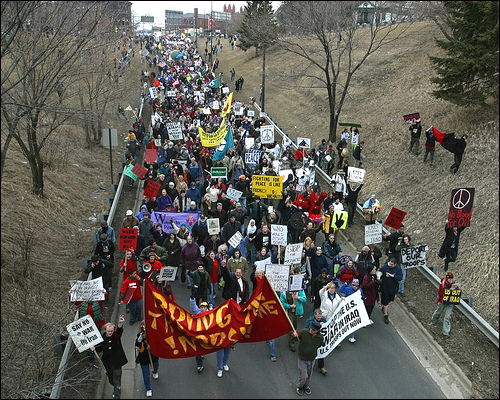
[Opinion] Thoughts occasioned by a peace march in Minneapolis

Mikael Jonathan Rudolph (MikaelMN)

The Minneapolis (Minnesota) Star Tribune accurately portrayed the local peace march and rally that took place this past Sunday and appropriately featured it as Monday morning's number one story "above the fold" on its front page along with a large photograph of the marchers similar to this one taken nearly simultaneously.


ⓒ2007 Kayakbiker


This is yet another sign of steadily growing citizen opposition to the disastrous, failed policies of President Bush, along with Saturday's march on the Pentagon and similar protests around the nation and the world. The effectiveness of citizen protest and calls for peace, however, is certainly questionable as peace advocates marched once again in what is becoming an Iraq invasion anniversary tradition.

President Bush and Secretary of State Condoleezza Rice have made it abundantly clear that no matter what the new majority of Democrats in Congress pass as legislation in opposition to the war, it will be vetoed, ignored or otherwise circumvented. This war will continue. Innocent Iraqis will continue to suffer terribly -- caught in the middle between their American occupiers, the "insurgent" resistance and the battling opposing forces of the burgeoning Sunni-Shiite civil war.

By this time next year another thousand American families will have flag-draped caskets come home instead of sons, daughters, fathers, or mothers. The number of horrendously damaged souls doomed to be relegated to holding cardboard signs on our street corners over the next couple of decades goes up every day.

No amount of protesting, no amount of candle-wax burned, no amount of letter writing, calls or e-mails of complaint to our Representatives and Senators will end this war.

The war was illegal from the start as a preemptive war of aggression banned by the Geneva Accords. The Bush administration clearly knew Iraq posed no imminent threat to the United States and yet ordered the attack and occupation anyway of the sovereign nation whose only real crime was having the audacity to live on top of one of the world's largest oil fields.

We American citizens were lied to. The world was lied to. Most critically, Congress was lied to. The "intelligence was fixed to justify the policy" as made clear by the Downing Street Memo.

The plans to invade Iraq were clarified in 1998 according to the "Project for a New American Century" a Neo-Conservative think tank. All that was needed was a "new Pearl Harbor" to justify it. This was made clear in an article published as: Rebuilding America's Defenses (page 51).

Participants in PNAC included:

  • Vice President Dick Cheney
  • Cheney's recently convicted former top aide I. Lewis "Scooter" Libby CIA leaker
  • World Bank President Paul Wolfowitz
  • U.S. ambassador to Iraq Zalmay Khalilzad
  • Former Secretary of Defense Donald Rumsfeld Not Gone?
  • Former Florida Governor and George W. Bush's brother Jeb Bush
  • Former U.N. Ambassador John Bolton
  • Former Deputy Secretary of State Richard Armitage CIA leaker
  • Former "Drug Czar" William Bennett
  • Former Vice President Dan Quayle
  • Fellow high profile conservatives Richard Perle, William Kristol and others.

The authors of the PNAC document got their "New Pearl Harbor" wish on Sept. 11, 2001 and the Bush administration has failed to thoroughly investigate the financing, planning, execution and cover up of the crimes of 9/11 ever since.

Despite there not being an iota of truth to the administration's claims of Saddam's connections to Al Qaeda, Osama bin Laden or 9/11, they are still talking about them all in the same breath repeatedly to manipulate the uninformed. Even so, America's patience with this war is plummeting, yet public opinion holds no sway with these war criminals the Hague is considering prosecuting along with British Prime Minister Tony Blair.

The "War on Terror" is an eternal commitment to imperialism, it isn't a conflict that can be won because the declared enemy isn't a nation state nor is it a people group. It is a quasi-military tactic. We might as well declare war against bullets.

The Iraq War is not ending, it is escalating. The next escalation is already assured. According to some media sources covert pre-op military action is allegedly already taking place across the border in Iran. (New Yorker, RAW STORY.) Iran is almost certain to be attacked by the U.S. and/or Israel within the next few months. National Democratic Party leadership pressure and American Citizen pressure may have delayed this, but it is still in the works. There is a fourth aircraft carrier group heading to the Gulf as a "replacement" to arrive very soon. The likely timing for an attack is while all four carrier groups are there and before one group is rotated out.

Rep. Dennis Kucinich (D-OH) had the courage, the integrity and basic common sense to recognize that there is only one way to pull the plug on this American war-for-profit machine last Thursday when he spoke to the House of Representatives:

"This House cannot avoid its constitutionally authorized responsibility to restrain the abuse of executive power.

"The administration has been preparing for an aggressive war against Iran. There is no solid, direct evidence that Iran has the intention of attacking the United States or its allies.

"The U.S. is a signatory to the U.N. Charter, a constituent treaty among the nations of the world. Article II, Section 4 of the U.N. Charter states, 'all members shall refrain in their international relations from the threat or use of force against the territorial integrity or political independence of any state...' Even the threat of a war of aggression is illegal.

"Article VI of the U.S. constitution makes such treaties the supreme law of the land. This administration, has openly threatened aggression against Iran in violation of the U.S. constitution and the U.N. charter.

"This week the House appropriations committee removed language from the Iraq war funding bill requiring the administration, under article 1, section 8, clause 11 of the Constitution, to seek permission before it launched an attack against Iran.

"Since war with Iran is an option of this administration and since such war is patently illegal, then impeachment may well be the only remedy which remains to stop a war of aggression against Iran."

"Impeachment may well be the only remedy which remains to stop a war of aggression against Iran." -- Rep. Dennis Kucinich (D-OH)

If we American citizens are not working for the impeachment of President Bush and Vice President Cheney and the removal from office of their entire administration we are not working for peace. Other efforts are noble, well-intended and honorable but absolutely impotent in the face of this voraciously bloodthirsty evil.

Martin Luther King had to take his legion across the bridge into a bloodbath provoked by a racist police force in Selma, Alabama, and Mahatma Ghandi marched his followers to the sea in resistance to the British military in order for true change to occur. It is long past time for the citizens of this nation, so many of whom call themselves Christians, to "storm the temple" as Jesus of Nazareth did and evict the moneychangers in the White House, utilizing the authority granted us in our constitution. That authority and mechanism for accountability and justice is called impeachment.

Who is ready to march with a petition of memorial to their Representative insisting on justice through impeachment for war crimes? We've been asking nicely for peace for four years (much longer for many, I know). It is time that we demand the justice that is the only way through which peace will come:

DIY Impeachment

Parents, when "asking nice" accomplishes absolutely nothing, know the next method of healthy discipline for their children is to be more authoritative. It is time to take away their toys.

Time out Mr. Bush.

Time out Mr. Cheney.

Time out.

Peaceful marchers: See you at next year's rally or are you ready to realize "the only remedy that remains" to secure the peace you seek is impeachment of President George W. Bush and Vice President Dick Cheney?

A version of this article also appeared on www.ImpeachforPeace.org

2007/03/20