Showing posts with label dollar. Show all posts

Tuesday, April 24, 2007

Dollar Still Falling, Nears All-Time Lows: Bonddad

April 24, 2007

By Bonddad
bonddad@prodigey.net

From Investor's Business Daily (subscription only):

The dollar last week sank to a 26-year low against the British pound and is nearing record lows vs. the euro. Even the lowly Japanese yen has gained some ground against the greenback.

Analysts say the dollar's fall is the result of a cyclical shift in the global economy: Growth and interest rates in Europe and Asia are outpacing those in America, drawing capital away from U.S. stocks, bonds and other assets.

"There are reasons to be bullish about other currencies, and that's why people are moving out of the U.S. dollar," said David Watt, senior foreign exchange strategist at RBC Capital Markets.

There are numerous reasons for the dollars decline.

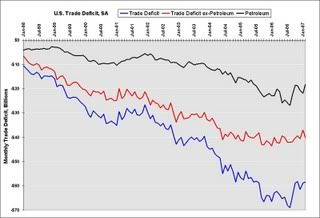
1.) While the trade deficit appears to be moderating, it is still at high levels. Here is a chart from the Blog Calculated Risk. The lowest line is the overall trade deficit. The middle line represents oil imports and the top line represents oil imports only. Currency traders are selling the dollar partly because the US consumes more than it makes (which the trade deficit represents).

Photo Sharing and Video Hosting at Photobucket

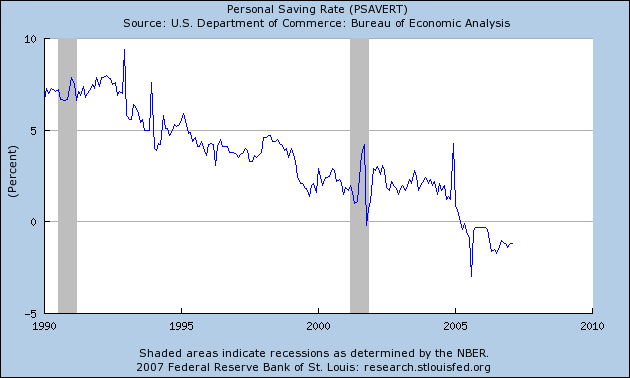
2.) The US savings rate is still negative, indicating the trade deficit must be financed from abroad. So long as the US economy has to have international financing to pay its bills, traders will lose confidence in the dollar.

Photo Sharing and Video Hosting at Photobucket

To finance the trade deficit, the US and its trading partners are engaged in an "economic merry-go-round:"

But another baby step of a 27-basis-point rate increase will do little to cool the steamy Chinese economy or markets. To prevent a faster rise in its currency, the Chinese monetary authorities had to buy a staggering $136 billion in the first quarter alone, bringing China's foreign-exchange reserves to $1.2 trillion.

To buy up greenbacks, the PBOC "prints" yuan, colloquially speaking. The dollars are invested primarily in Treasuries and U.S. agency securities, with the salubrious effect of financing the U.S. budget and current-account deficits, in turn bolstering the dollar and holding down U.S. interest rates.

That this dollar merry-go-round cannot go on forever is at the core of the dollar bears' argument. The massive U.S. current-account deficit has to be funded, either through these political contrivances or capital inflows.

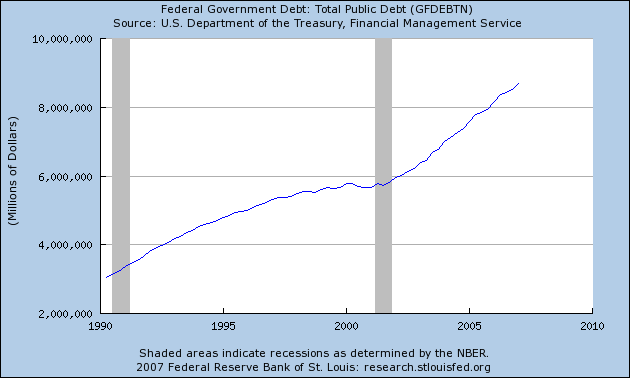
3.) The US Federal Deficit is far from "under control". The figures reported in the press (and by the Bush administration) include the Social Security surplus. Unfortunately, the US government is spending this money now instead of actually saving it (even US politicians have no idea how to save). This means the US will eventually have to pay all this debt back, which means we will have fiscal problems going forward.

Photo Sharing and Video Hosting at Photobucket

4.) Other countries rate of growth is increasing. According to the International Monetary Funds World Economic Outlook, the rest of the world's growth is doing pretty well. That means other currencies are more attractive.

5.) While US interest rates are still some of the best around, other countries/regions are starting to raise their rates for various reasons. As the IBD article noted:

The European Central Bank and policymakers in China and Japan also are leaning toward rate hikes amid relatively robust growth and expectations of higher inflation.

Meanwhile, the Federal Reserve is likely to stay on hold for the foreseeable future. Policymakers are betting that subpar growth will cool inflation, which is still above the Fed's 1%-2% comfort zone.

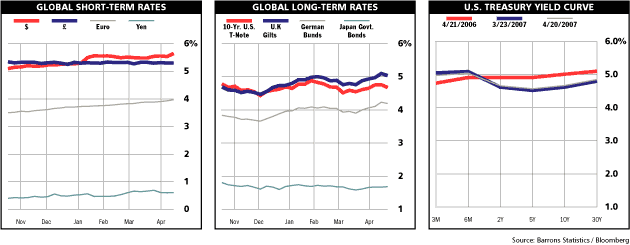
The EU has raised rates over the last year or so, and Japan actually has interest rates above 0% (they stand at .5% now). While Japan still has a long way to go before they reach parity with the US, their announcement a few months ago to raise interest rates sent a shock through the financial markets as it signaled the carry-trade (borrowing in Japan and lending anywhere else) was no longer a given (the chart is from Barron's).

Photo Sharing and Video Hosting at Photobucket

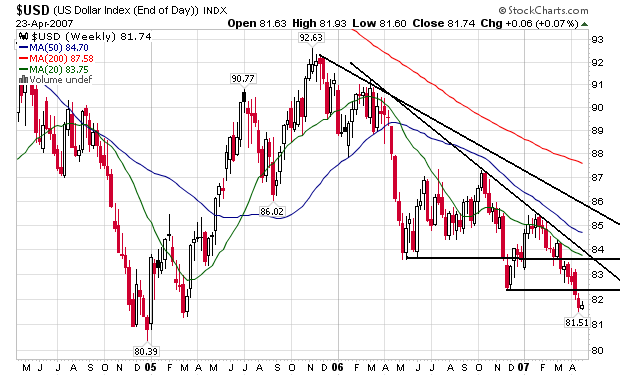
6.) The actual chart of the dollar has nothing but bearish implications. Note the following:

-- The overall trend is clearly down

-- The 20, 50 and 200 day simple moving averages are all heading lower

-- The overall index is trading below the moving averages, meaning price action will continue to pull the moving averages lower.

Photo Sharing and Video Hosting at Photobucket

The conclusion from all this? There is no news that is dollar bullish and plenty of news that is dollar bearish.

For economic commentary and analysis, go to the Bonddad blog

Friday, April 13, 2007

Euro hits new two-year high against dollar

Related
Wholesale prices up 1 percent in March


2 hours, 54 minutes ago

The euro surged on Friday to 1.3534 dollars, the highest level since January 3, 2005, on expectations of rising eurozone interest rates.

They added that the foreign exchange market was jittery ahead of a meeting of the Group of Seven (G7) financial chiefs in Washington on Friday, when the health of the global economy and the weakness of the yen are expected to be in focus.

The single currency later stood at 1.3521 dollars, compared with 1.3480 dollars in New York late on Thursday. The euro dipped to 160.06 yen after striking an overnight record of 160.87 against the Japanese unit.

The dollar meanwhile fell to 118.38 yen compared with 119.14 late on Thursday.

"The dollar has been depressed against the euro by the comments of (ECB) President (Jean-Claude) Trichet yesterday (Thursday) following the monetary policy meeting of the European Central Bank," said Paul Chertkow, head of global currency research at The Bank of Tokyo-Mitsubishi in London.

The euro had breached 1.35 dollars on Thursday after the ECB signalled that it was ready to raise eurozone borrowing costs again in June.

Trichet sent a clear signal that the bank was set to raise its key interest rates -- already at a five-and-a-half-year high -- still further in June, after holding rates at 3.75 percent on Thursday.

"Characterising monetary policy as still accommodative, he (Trichet) underpinned the expectation of another 0.25 point increase in the refinancing rate in the eurozone before mid-year," Chertkow added.

The euro has been buoyed in recent weeks by favourable interest rate differentials, analysts said.

In contrast with the ECB, the US Federal Reserve appeared to open the door to a cut in American borrowing costs last month as it kept rates unchanged at 5.25 percent.

Market players were cautious on Friday ahead of the G7 meeting amid speculation that the yen could become a topic of discussion, if only behind closed doors.

The weakening Japanese yen is causing consternation in European capitals, where finance chiefs are worried that the yen-euro exchange rate is penalising eurozone exporters.

"But the chances of strong remarks on a weak yen are very slim this time," said Tokyo-based Commerzbank analyst Ryohei Muramatsu.

"And since foreign exchange rates are stable in an orderly manner right now, there is no need for the G7 to say anything that may possibly disturb the market," he said.

Ahead of the G7 talks, the dollar could face further selling pressure from new data in the United States, with the latest US trade balance data and producer price inflation numbers due later Friday.

The euro was changing hands at 1.3521 dollars, against 1.3480 dollars late on Thursday, 160.06 yen (160.62), 0.6811 pounds (0.6812) and 1.6364 Swiss francs (1.6396).

The dollar stood at 118.38 yen (119.14) and 1.2101 Swiss francs (1.2167).

The pound was being traded at 1.9860 dollars (1.9785).

On the London Bullion Market, the price of gold pulled back to 677.25 dollars per ounce, from 678.50 dollars late on Thursday.

Wednesday, April 11, 2007

Doomsday for the Greenback

Related
CBS Marketwatch: Gold Hits 5-wk. High on Dollar Slide, Trade Tensions
---
April 10, 2007

By Mike Whitney

“Of all the contrivances for cheating the laboring classes of mankind, none has been more effective than that which deludes them with paper money.” Daniel Webster


The American people are in La-la land. If they had any idea of what the Federal Reserve was up to they’d be out on the streets waving fists and pitchforks. Instead, we go our business like nothing is wrong.

Are we really that stupid?

What is it that people don’t understand about the trade deficit? It’s not rocket science. The Current Account Deficit is over $800 billion a year. That means that we are spending more than we are making and savaging the dollar in the process. Presently, we need more than $2 billion of foreign investment per day just to keep the wheels from coming off the cart.

Everyone agrees that the current trade imbalances are unsustainable and will probably trigger major economic disruptions that will thrust us towards a global recession. Still, Washington and the Fed stubbornly resist any change in policy that might reduce over-consumption or reverse present trends.

It’s madness.

The investor class loves big deficits because they provide cheap credit for Bush’s lavish tax cuts and war. The recycling of dollars into US Treasuries and dollar-based securities is a neat way of covering government expenses and propping up the stock market with foreign cash. It’s a “win-win” situation for political elites and Wall Street. For the rest of us it’s a dead-loss.

The trade deficit puts downward pressure on the dollar and acts as a hidden tax. In fact, that’s what it is--a tax! Every day the deficit grows, more money is stolen from the retirements and life savings of working class Americans. It’s an inflation bombshell obscured by the bland rhetoric of “free markets” and deregulation.

Consider this: In 2002 the euro was $.87 on the dollar. Last Friday (4-6-07) it closed at $1.34-- a better than 50% gain for the euro in just 4 years. The same is true of gold. In April 2000, gold was selling for $279 per ounce. Last Friday, at the close of the market it skyrocketed to $679.50---more than double the price.

Gold isn’t going up; it’s simply a meter on the waning value of the dollar. The reality is that the dollar is tanking big-time, and the main culprit is the widening trade deficit.

The demolition of the dollar isn’t accidental. It’s part of a plan to shift wealth from one class to another and concentrate political power in the hands of a permanent ruling elite. There’s nothing particularly new about this and Bush and Greenspan have done nothing to conceal what they are doing. The massive expansion of the Federal government, the unfunded tax cuts, the low interest rates and the steep increases in the money supply have all been carried out in full-view of the American people. Nothing has been hidden. Neither the administration nor the Fed seem to care whether or not we know that we’re getting screwed --it’s just our tough luck. What they care about is the $3 trillion in wealth that has been transferred from wage slaves and pensioners to brandy-drooling plutocrats like Greenspan and his n’er-do-well friend, Bush.

These policies have had a devastating effect on the dollar which has been slumping since Bush took office in 2000. Now that foreign purchases of US debt are dropping off, the greenback could plunge to even greater depths. There’s really no way of knowing how far the dollar will fall.

That puts us at a crossroads. We are so utterly dependent on the “charity of strangers” (foreign investment) that a 9% blip in the Chinese stock market (or even a .25 basis point up-tick in the yen) sends Wall Street into a downward spiral. As the housing market continues to unwind, the stock market (which is loaded with collateralized mortgage debt) will naturally edge lower and foreign investment in US Treasuries and securities will dry up. That’ll be doomsday for the greenback as central banks across the planet will try to unload their stockpiles of dollars for gold or foreign currencies.

That day appears to be quickly approaching as the 3 powerhouse economies are overheating and need to raise interest rates to stifle inflation. This will make their bonds and currencies all the more attractive for foreign investment; diverting much needed credit from American markets.

Just imagine the effect on the already-hobbled housing market if interest rates were suddenly to climb higher to maintain the flow of foreign capital?

The ECB (European Central Bank), Japan and China are all cooperating in an effort to “gradually” deflate the dollar while minimizing its effects on the world economy. In fact, China even waited until the markets had closed on Good Friday to announce another interest rate increase. Clearly, the Chinese are trying to avoid a repeat of the 400 point one-day bloodbath on Wall Street in late February ‘07.

Japan has also tried to keep a lid on interest rates (and allowed the carry trade to persist) even though commercial property in Tokyo is “red hot” and liable to spark a ruinous cycle of speculation.

But how long can these booming economies avoid the interest rate hikes that are needed for curbing inflation in their own countries? The problem is, of course, that by fighting inflation at home they will ignite inflation in the US. In other words, by strengthening their own currencies they weaken the dollar--it’s unavoidable.

This is bound to hurt consumer spending in the US which will ripple through the entire global economy.

The problems presented by the falling dollar can’t be resolved by micromanaging or jawboning. In truth, there’s no more chance of a “soft landing” for the dollar than there is for the over-bloated real estate market. Greenspan’s bubble economy is headed for disaster and there’s not much that anyone can do to lessen the damage. As housing prices fall and homeowners are no longer able to tap into their equity, consumer spending will slow, the economy will shrink and the Fed will be forced to lower interest rates.

Unfortunately, at that point, lowering rates won’t be enough. Interest rates need at least 6 months to take hold and, by then, the steady drumbeat of foreclosures and falling real estate prices will have soured the public on an entire “asset class” for years to come. Many will see their life savings dribble away month by month as prices continue to nose-dive and equity vanishes into the ether. These are the real victims of Greenspan’s low interest rate swindle.

The Federal Reserve is fully aware of the harm they have inflicted with their low interest rate boondoggle. In a 2006 statement the Fed even acknowledged that they knew that trillions of dollars in speculation was being funneled into the real estate market:

"Like other asset prices, house prices are influenced by interest rates, and in some countries, the housing market is a key channel of monetary policy transmission."

“Monetary transmission” indeed?!? Trillions of dollars in mortgages were issued to people who have no chance of paying them back. It was a shameless scam. Still, the policy persisted in a desperate attempt to keep the US economy from collapsing into recession. The upshot of this misguided policy was “the largest equity bubble in history” which now threatens America’s economic solvency.

Author Benjamin Wallace commented on the Fed’s activities in an article in the Atlantic Monthly, “There Goes the Neighborhood: Why home prices are about to plummet—and take the recovery with them”:

"Let's assume for a moment that enough people get fooled, and the refinancing boom gets extended for another year. Then what? The real problem hits. Because if you think Greenspan's being cagey on refinancing, the truth he's really avoiding talking about is that we're in the midst of a huge housing bubble, on a scale only seen once before since the Depression. Worse, the inflated housing market is now in an historically unique position, as the motor of the rest of the economy. Within the next year or two, that bubble is likely to burst, and when it does, it very well may take the American economy down with it."

Or this from Robert Shiller in his “Irrational Exuberance”:

"People in much of the world are still overconfident that the stock market, and in many places the housing market, will do extremely well, and this overconfidence can lead to instability. Significant further rises in these markets could lead, eventually, to even more significant declines. The bad outcome could be that eventual declines would result in a substantial increase in the rate of personal bankruptcies, which could lead to a secondary string of bankruptcies of financial institutions as well. Another long-run consequence could be a decline in consumer and business confidence, and another, possibly worldwide, recession”.

If it is not handled properly, the housing collapse could result in another Great Depression. America no longer has the (manufacturing) capacity to work its way out of a deep recession. While the Fed was sluicing $11 trillion into the real estate market via low interest loans; America’s manufacturing sector was being carted off to China and India in the name of globalization. Without capital investment and increased factory production, economic recovery will be difficult if not impossible. The so-called “rebound” from the 2001 recession was due to artificially low interest rates and easy credit which inflated the housing market. It had nothing to do with increases in productivity, exports, or paying off old debts. In other words, the “recovery” was not real wealth creation but simply credit expansion. There’s a vast chasm between “productivity” and “consumption” although Greenspan never seemed to grasp the difference.


A penny borrowed is not the same as a penny earned—although both may cause a slight bump in GDP. Greenspan’s attitude was aptly summarized by The Daily Reckoning’s Addison Wiggin who said, “GDP measures debt-fueled consumption--it really only measures the rate at which America is going broke”.

Bingo.

America’s biggest export is its fiat-currency which foreigners are increasingly hesitant to accept.

Can you blame them?

They have begun to figure out that we have no way of repaying them and that the “full faith and credit” of the United States is about as reliable as a Ken Lay-managed 401-K retirement plan.

The fragility of the US economy will become more apparent as Greenspan’s housing bubble continues to lose air and consumer spending remains flat. As we noted earlier, home equity withdrawals are drying up which will slow growth and discourage foreign investment. The meltdown in subprime loans has drawn more attention to the maneuverings of the banks and mortgage lenders and many people are getting a clearer understanding of the Federal Reserve’s role in creating this economy-busting monster-bubble.

The 10% to 20% yearly increases in property values are unprecedented. They are “pure bubble” and have nothing to do with increases in wages, demand, productivity, capital investment or GDP. It was all “froth” generated by the world’s greatest Frothmeister, Alan Greenspan.

As Addison Wiggin notes, “There is only one real source of wealth: a healthy and competitive environment involving the exchange of goods coupled with control over deficit spending.”

Elites at the Federal Reserve and in the Bush administration have steered us away from this “tried and true” course and put us on the path to debt and catastrophe. It won’t be easy to restore our manufacturing base and compete again in the open market, but it must be done. Strong economies require that their people produce things that other people want. This is a fundamental truism that has been lost in the smoke and mirrors of Greenspan’s shenanigans at the Fed.

Regrettably, we are probably facing a decades-long economic downturn in which the dollar will weaken, stocks will fall, GDP will shrivel, and traditional standards of living will decline.

The trend-lines in the real estate market will most likely be the inverse of what they have been for the last 10 years. This will dramatically affect consumer spending (70% of GDP) and put additional pressure on the dollar.

The dollar is already in big trouble--the only thing keeping it afloat is foreign purchases of US debt by creditors who don’t want to be left holding trillions in worthless paper.(US debt is Japan’s single greatest asset!) These “net inflows” have created a false demand for the dollar which will inevitably dissipate as central banks continue to diversify.

Last week the IMF issued a warning that there would have to be a “substantial” decline in the dollar to bring the trade deficit to sustainable levels. That, of course, is the intention of the Fed and Team Bush—to reduce the debt-load by deflating the currency. It’s a crazy idea. No one destroys the buying power of their currency to pay off their debts. It just illustrates the recklessness of the people in charge.

Also, on March 20, 2007 the Governor of China’s Central Bank Zhou Xiaochuan announced “that China will not accumulate more foreign reserves and will cut a small amount of current reserves for the formulation of a new currency agency”. Zhou’s statement is a hammer-blow to the dollar. The US needs roughly $70 billion in foreign investment per month to cover its current trade deficit. China is one of the largest purchasers of US debt. If China diversifies, then the dollar will fall and the aftershocks will ripple through markets across the world.

The Chinese are very careful about how they word their economic statements. That’s why we should take Zhou’s comments seriously. Three weeks ago he issued an equally ominous statement saying, “China will diversify its $1 trillion foreign exchange reserves, the largest in the world, across different currencies and investment instruments, including in emerging markets.” (Reuters)

This should have been a red flag for currency traders, but the media buried the story and the markets dutifully shrugged it off. The truth is that our relationship with the Chinese is changing very quickly and the days of cheap credit and a “high-flying” dollar are coming to an end.

70% of China’s currency reserves are in US dollars. The effect of “diversification” will be devastating for the US economy. It increases the likelihood of hyperinflation at the same time the housing market is in its steepest decline in 80 years. When currency crises arise at the same time as economic crises; the problems are much more difficult to resolve.

Doomsday for the Greenback

It is impossible to fully anticipate the effects of the falling dollar. The dollar is a currency unlike any other and it is the cornerstone of American power—political, economic and military. As the internationally-accepted reserve currency, it allows the Federal Reserve to control the global economic system by creating credit out of “thin air” and using fiat-scrip in the purchase of valuable manufactured goods and resources. This puts an unelected body of private bankers in charge of setting interest rates which directly affect the entire world.

Iraq has proven that the US military can no longer enforce dollar-hegemony through force of arms. New alliances are forming that are reshaping the geopolitical landscape and signal the emergence of a multi-polar world. The decline of the superpower-model can be directly attributed to the denominating of vital resources and commodities in foreign currencies. America is simply losing its grip on the sources of energy upon which all industrial economies depend. Iraq is the tipping point for America’s global dominance.

When foreign central banks abandon the greenback the present system will unwind and the “unitary” model of world order will abruptly end.

This may be a painful experience for Americans who will undoubtedly see a sharp fall in current living standards. But it also presents an opportunity to disband the Federal Reserve and restore control of the nation’s currency to the people’s legitimate representatives in the US Congress.

This is the first step towards removing the cabal of powerbrokers in both political parties who solely represent the narrow ambitions of private interests.

The War on Terror is a public relations ploy that is intended to disguise the use of military and covert operations to secure dwindling resources to maintain dollar supremacy. It is a futile attempt to control the rise of China, India, Russia and the developing world while preserving the authority of western white elites.

The strength of the euro portends increasing competition for the dollar and a steady decline in America’s influence around the world. This should be seen as a positive development. Greater parity between the currencies suggests greater balance between the states--hence, more democracy. Again, the superpower model has only increased terrorism, militarism, human rights violations and war. By any objective standard, Washington has been a poor steward of global security.

The falling dollar also suggests growing political upheaval at home brought on by economic distress. We should welcome this. America needs to remake itself—to recommit to its original principles of personal freedom, civil liberties and social justice--to reject the demagoguery and warmongering of the Bush regime—to reestablish our belief in habeas corpus, the presumption of innocence and the rule of law. Most important, we need to reclaim our honor.

Big changes are coming for the dollar; it’s just a matter of whether we allow those changes to bog us down in recriminations and pessimism or use them to create a new vision of America and restore the principles of republican government. It’s up to us.
Tuesday, March 27, 2007

China shifts to euros for Iran oil

By Chen Aizhu

BEIJING (Reuters) - China's state-run Zhuhai Zhenrong Corp, the biggest buyer of Iranian crude worldwide, began paying for its oil in euros late last year as Tehran moves to diversify its foreign reserves away from U.S. dollars.

The Chinese firm, which buys more than a tenth of exports from the world's fourth-largest crude producer, has changed the payment currency for the bulk of its roughly 240,000 barrels per day (bpd) contract, Beijing-based sources said.

Japanese refiners who buy about 500,000 bpd of Iranian crude, nearly a quarter of Iran's 2.2 million-bpd shipments, continue to pay in dollars but are willing to shift to yen if asked, industry sources and officials said separately.

Iranian officials have said for months that more than half the OPEC member's customers switched their payment currency away from the dollar as Tehran seeks to diversify its reserves, but news of the Zhenrong change is the first outside confirmation.

The price of the oil is still based on dollar quotes.

The shift, being watched closely by foreign exchange traders, comes amid an extended row between Tehran and Washington over Iran's nuclear programme.

China, which depends on Iran for about 12 percent of its imported crude oil, has at times used the threat of its United Nations veto to blunt Western measures.

The UN imposed new sanctions on Iran on Saturday as Tehran refused to halt its nuclear programme, targeting arms exports and 28 Iranian individuals and entities.

Iran's central banker told Reuters earlier on Tuesday that Tehran had cut its holding of U.S.-dollar assets to a minimum level of around a fifth of its foreign reserves in response to U.S. hostility, still enough to handle major shocks.

CHINA SWITCHES EARLY

"Most of China's purchases have shifted to euro. It's not difficult so long as our banks can handle that," said a Chinese state oil trader.

Hojjatollah Ghanimifard, head of international affairs at the National Iranian Oil Company (NIOC), told Reuters last week that around 60 percent of its oil income was in non-dollar currencies as almost all of Iran's European clients and some of its Asian customers had agreed to make non-dollar payments.

Iran is China's third-largest crude supplier with daily volume of 335,000 barrels last year. Sinopec Corp. <0386.hk>, Asia's top refiner but a minor lifter of Iranian oil, is still paying in U.S. dollars, said a Sinopec trader.

Japanese buyers, including top refiner Nippon Oil Corp. <5001.t>, said they had all received inquiries from Iran to pay on non-U.S. dollar terms, but were awaiting an official request.

"We are looking at it so that we can switch the currencies any time, but we have not gotten any official requests from them (NIOC). We are doing the transactions in dollars (now)," Nippon Oil chairman Fukuaki Watari told reporters last week.

Sources with other majors refiners concurred.

Iran ranks as Japan's third-largest crude supplier so far this year with daily rate of just under 500,000 bpd.

Tokyo has cautioned world powers against including oil in sanctions they may impose on Iran for its refusal to suspend atomic work, which the U.S. says is aimed at developing a nuclear weapon, but Tehran insists is for generating electricity.

Iran's major European customers include Royal Dutch Shell , France's Total and Spain's Repsol . The United States has banned imports of Iranian crude since 1995.

(Additional reporting by Ikuko Kao in Tokyo)

(c) Reuters 2007. All rights reserved. Republication or redistribution of Reuters content, including by caching, framing or similar means, is expressly prohibited without the prior written consent of Reuters. Reuters and the Reuters sphere logo are registered trademarks and trademarks of the Reuters group of companies around the world.

Gulf economies to 'drop the dollar'

Nasser al-Shaali believes Gulf states will look at eastern markets 'aggressively' [Reuters]

Gulf economies will move away from a dollar currency peg and shift foreign exchange reserves away from dollar to other currencies, including the Chinese yuan, the chief executive of Dubai International Financial Centre (DIFC) has said.

Nasser al-Shaali noted that the UAE central bank had already started buying euros - part of its strategy to move about 10 per cent of its reserves into the single European currency before the end of the year.

"We've seen, for example in the case of the UAE central bank, a movement into the euro," al-Shaali told the Reuters Middle East Investment Summit.

"In the future, most likely, we predict some of the economies in the region will adopt the Chinese yuan currency as well," he said, noting that he was not aware of that happening at the moment.


He said the appetite of the region as a whole was to increasingly diversify exposure.

"The investment strategies of Dubai Holdings entities, Kuwait Investment Authority and so on ... you will see a lot of these bodies start looking at Eastern Asia more aggressively along with a lot of institutional and private investors in the region," he said.

Deadlines

Saudi Arabia, the largest Gulf Arab economy, as well as Qatar, Oman and Bahrain have ruled out changes to their dollar pegs, adopted in preparation for a monetary union planned for 2010.

But the UAE and Kuwait, the third largest economy, have questioned the peg after the dollar fell about 10 per cent against the euro last year.

A Reuters poll of 15 analysts last week showed Gulf Arab states will probably not meet the deadline for currency union as member nations grapple with inflation and budget criteria, but Kuwait may revalue its currency before then.

Twelve of the 15 analysts, surveyed between March 16-20, said it was unlikely or very unlikely that the six members of the Gulf Corporation Council (GCC), representing the world's biggest oil exporting region, would meet its single currency target in three years.

Thursday, March 22, 2007

Reasons Why the U.S. Economy is Much More Vulnerable Than it Was in 2001

Mar 21st, 2007

A study recently published by the Bank for International Settlements (Monetary and Prudential Policies at a Crossroad?) says:

“Financial liberalization is undoubtedly critical for the better allocation of resources and long-term growth. The serious costs of financial repression around the world have been well documented. But financial liberalization has also greatly facilitated the access to credit… more than just metaphorically. We have shifted from a cash flow-constrained to an asset-backed economy.”

Though we basically agree with the analysis and the conclusions of the study, we radically disagree with the one sentence that “Financial liberalization is undoubtedly critical for the better allocation of resources and long-term growth.” The indispensable first condition for proper resource allocation at a national as well as global scale is avoidance of excessive money and credit creation. In many countries, and in particular in the United States, they are excessive as never before.

If Mr. Bernanke complains about irregularities of M2, this is nothing in comparison with the fact that credit and debt growth in the United States has exploded for more than two decades. When Mr. Greenspan took over at the helm of the Fed in 1987, outstanding debt in the United States totaled $10.5 billion. In less than 20 years, this sum has quadrupled to $41.9 billion. In reality, this significantly understates the rise in debts because, for example, highly leveraged hedge funds with trillions of outstanding debts are not captured. In 1987, indebtedness was equivalent to 223% of GDP, which was already pretty high. Lately, it is up to 317% of GDP.

In actual fact, there used to be a very stable relationship between money or credit growth and GDP or income growth until the early 1980s. Growth of aggregate outstanding indebtedness of all nonfinancial borrowers - private households, businesses and government - had narrowly hovered around $1.40 for each $1 of the economy’s gross national product. Debt growth of the financial sector was minimal.

The breakdown of this relationship started in the early 1980s. Financial liberalization and innovation certainly played a role. But the most important change definitely occurred in the link between money and credit growth to asset markets. Money and credit began to pour into asset markets, boosting their prices, while the traditional inflation rates of goods and services declined. The worst case of this kind at the time was, of course, Japan.

Do not be fooled by the sharp decline in consumer borrowing into the belief that money and credit has been tightened in the United States. Instead, borrowing for leveraged securities purchases (in particular, carry trade and merger and acquisition financings) has been outright rocketing, with security brokers and dealers playing a key role. Over the three quarters of 2006, their net acquisitions of financial assets have been running at an annual rate of more than $600 billion, more than double their expansion in the past.

Federal funds and repurchase agreements expanded in the third quarter at an annual rate of $606.3 billion, or an annual 26%. The main borrowers were brokers and dealers. During the first three quarters of the year, their assets increased $427 billion, or 27% annualized, to $2.57 billion. A large part of the money came from the highly liquid corporations. There is no reason to wonder about low and falling long-term interest rates.

All this confirms that financial conditions remain extraordinarily loose. Even that is a gross understatement. Credit for financial speculation is available at liberty. Expectations for weaker economic activity only foster greater financial sector leverage. Why such unusually aggressive speculative expansion in the face of a slowing economy?

The apparent explanation is that the financial sector intends to make the greatest possible profit from the coming decline of interest rates, promising further rises in asset prices against falling interest rates. While the real economy slows, the leveraged speculation by the financial fraternity goes into overdrive. Principally, there is nothing new about such speculation. New, however, is its exorbitant scale.

Before leading his jumbo-sized delegation to Beijing, Henry Paulson, U.S. Treasury secretary, cautioned against expecting any big breakthroughs from the visit. And so it has turned out. The meeting produced plenty of statements about the desirability of improving relations, but nothing concrete to do so.

Of course, the Chinese are in a very strong position with the central bank holding more than $1 trillion of bonds in its portfolio, mostly denominated in dollars. According to reports, the American visit was initiated by Mr. Paulson in an effort to contain rising Sinophobia in the U.S. Congress, which increasingly blames China for America’s economic problems, from its huge current account deficit to stagnating real incomes. In other words, those troublemakers, not the trade deficit, are the problem.

One cannot say that U.S. policymakers and economists have been preoccupied with worries about possible harmful effects of the exploding trade deficit. They appear obsessed with the conventional wisdom that free trade is good and must always be good under any and all circumstances, as postulated in the early 19th century by David Ricardo.

Ricardo exemplified this by comparing trade in wine and cloth between Portugal and England. Portugal was cheaper in both products, but its comparative advantage was greater in wine. As a result, according to Ricardo, Portugal boosted its production and exports of wine. In contrast, England gave up its wine production and could produce more sophisticated goods. In both countries, living standards rose.

For sure, it appears highly plausible that American policymakers feel they are following Ricardo’s logic. Only they are disregarding some caveats of Ricardo’s. For equal benefit, first of all, balanced foreign trade is required. “Exports pay for imports” was a dogma of classical economic theory. Ricardo, furthermore, disapproved of foreign investment, with the argument that it slows down the home economy.

With an annual current account deficit of more than $800 billion, the U.S. economy is definitely a big loser in foreign trade. To offset this loss of domestic spending and income, alternative additional demand creation is needed. Essentially, all job losses are in high-wage manufacturing, and most gains are in low-wage services. In essence, the U.S. economy is restructuring downward, while the Chinese economy is restructuring upward.

Considering that Chinese wages are just a fraction of U.S. or European wages, it appears absurd that the Chinese authorities deem it necessary to additionally subsidize their booming exports by a grossly undervalued currency, held down by pegging the yuan to the dollar.

In the U.S. financial sphere, the year 2006 has set new records everywhere: records in stock prices, records in mergers and acquisitions, records in private equity deals, record-low spreads, record-low volatility. Manifestly, there is not the slightest check on borrowing for financial speculation. There is epic inflation in Wall Street profits.

One wonders what can stop this unprecedented speculative binge. Pondering this question, we note in the first place that the gains in asset prices - look at equities, commodities and bonds - have been rather moderate. To make super-sized profits, immense leverage is needed. We think the speculation is unmatched for its scope, intensity and peril. Plainly, it assumes absence of any serious risk in the financial system and the economy. The surest thing to predict is that the next interest move by the Fed will be downward.

In our view, the obvious major risk for speculation is in the economy - that is, in the impending bust of the gigantic housing bubble. Homeownership is broadly spread among the population, in contrast to owning stocks. So the breaking of the housing bubble will hurt the American people far more than did the collapse in stock prices in 2000-02. For sure, the U.S. economy is incomparably more vulnerable than in 2001. Another big risk is in the dollar.

Regards,

Dr. Kurt Richebacher
for The Daily Reckoning Australia