Showing posts with label economy. Show all posts

Tuesday, April 24, 2007

The Financialization of Capitalism

UPDATE - April 25, 2007 - Editor's note: I am posting at the the primary blog.

See yesterday's stories here below.

April 2007

by John Bellamy Foster

Changes in capitalism over the last three decades have been commonly characterized using a trio of terms: neoliberalism, globalization, and financialization. Although a lot has been written on the first two of these, much less attention has been given to the third.1 Yet, financialization is now increasingly seen as the dominant force in this triad. The financialization of capitalism—the shift in gravity of economic activity from production (and even from much of the growing service sector) to finance—is thus one of the key issues of our time. More than any other phenomenon it raises the question: has capitalism entered a new stage?

I will argue that although the system has changed as a result of financialization, this falls short of a whole new stage of capitalism, since the basic problem of accumulation within production remains the same. Instead, financialization has resulted in a new hybrid phase of the monopoly stage of capitalism that might be termed “monopoly-finance capital.”2 Rather than advancing in a fundamental way, capital is trapped in a seemingly endless cycle of stagnation and financial explosion. These new economic relations of monopoly-finance capital have their epicenter in the United States, still the dominant capitalist economy, but have increasingly penetrated the global system.

The origins of the term “financialization” are obscure, although it began to appear with increasing frequency in the early 1990s.3 The fundamental issue of a gravitational shift toward finance in capitalism as a whole, however, has been around since the late 1960s. The earliest figures on the left (or perhaps anywhere) to explore this question systematically were Harry Magdoff and Paul Sweezy, writing for Monthly Review.4

As Robert Pollin, a major analyst of financialization who teaches economics at the University of Massachusetts at Amherst, has noted: “beginning in the late 1960s and continuing through the 1970s and 1980s” Magdoff and Sweezy documented “the emerging form of capitalism that has now become ascendant—the increasing role of finance in the operations of capitalism. This has been termed ‘financialization,’ and I think it’s fair to say that Paul and Harry were the first people on the left to notice this and call attention [to it]. They did so with their typical cogency, command of the basics, and capacity to see the broader implications for a Marxist understanding of reality.” As Pollin remarked on a later occasion: “Harry [Magdoff] and Paul Sweezy were true pioneers in recognizing this trend....[A] major aspect of their work was the fact that these essays [in Monthly Review over three decades] tracked in simple but compelling empirical detail the emergence of financialization as a phenomenon....It is not clear when people on the left would have noticed and made sense of these trends without Harry, along with Paul, having done so first.”5

From Stagnation to Financialization

In analyzing the financialization of capitalism, Magdoff and Sweezy were not mere chroniclers of a statistical trend. They viewed this through the lens of a historical analysis of capitalist development. Perhaps the most succinct expression of this was given by Sweezy in 1997, in an article entitled “More (or Less) on Globalization.” There he referred to what he called “the three most important underlying trends in the recent history of capitalism, the period beginning with the recession of 1974–75: (1) the slowing down of the overall rate of growth, (2) the worldwide proliferation of monopolistic (or oligipolistic) multinational corporations, and (3) what may be called the financialization of the capital accumulation process.”

For Sweezy these three trends were “intricately interrelated.” Monopolization tends to swell profits for the major corporations while also reducing “the demand for additional investment in increasingly controlled markets.” The logic is one of “more and more profits, fewer and fewer profitable investment opportunities, a recipe for slowing down capital accumulation and therefore economic growth which is powered by capital accumulation.”

The resulting “double process of faltering real investment and burgeoning financialization” as capital sought to find a way to utilize its economic surplus, first appeared with the waning of the “‘golden age’ of the post-Second World War decades and has persisted,” Sweezy observed, “with increasing intensity to the present.”6

This argument was rooted in the theoretical framework provided by Paul Baran and Paul Sweezy’s Monopoly Capital (1966), which was inspired by the work of economists Michal Kalecki and Josef Steindl—and going further back by Karl Marx and Rosa Luxemburg.7 The monopoly capitalist economy, Baran and Sweezy suggested, is a vastly productive system that generates huge surpluses for the tiny minority of monopolists/oligopolists who are the primary owners and chief beneficiaries of the system. As capitalists they naturally seek to invest this surplus in a drive to ever greater accumulation. But the same conditions that give rise to these surpluses also introduce barriers that limit their profitable investment. Corporations can just barely sell the current level of goods to consumers at prices calibrated to yield the going rate of oligopolistic profit. The weakness in the growth of consumption results in cutbacks in the utilization of productive capacity as corporations attempt to avoid overproduction and price reductions that threaten their profit margins. The consequent build-up of excess productive capacity is a warning sign for business, indicating that there is little room for investment in new capacity.

For the owners of capital the dilemma is what to do with the immense surpluses at their disposal in the face of a dearth of investment opportunities. Their main solution from the 1970s on was to expand their demand for financial products as a means of maintaining and expanding their money capital. On the supply side of this process, financial institutions stepped forward with a vast array of new financial instruments: futures, options, derivatives, hedge funds, etc. The result was skyrocketing financial speculation that has persisted now for decades.

Among orthodox economists there were a few who were concerned early on by this disproportionate growth of finance. In 1984 James Tobin, a former member of Kennedy’s Council of Economic Advisers and winner of the Nobel Prize in economics in 1981, delivered a talk “On the Efficiency of the Financial System” in which he concluded by referring to “the casino aspect of our financial markets.” As Tobin told his audience:

I confess to an uneasy Physiocratic suspicion...that we are throwing more and more of our resources...into financial activities remote from the production of goods and services, into activities that generate high private rewards disproportionate to their social productivity. I suspect that the immense power of the computer is being harnessed to this ‘paper economy,’ not to do the same transactions more economically but to balloon the quantity and variety of financial exchanges. For this reason perhaps, high technology has so far yielded disappointing results in economy-wide productivity. I fear that, as Keynes saw even in his day, the advantages of the liquidity and negotiability of financial instruments come at the cost of facilitating nth-degree speculation which is short-sighted and inefficient....I suspect that Keynes was right to suggest that we should provide greater deterrents to transient holdings of financial instruments and larger rewards for long-term investors.8

Tobin’s point was that capitalism was becoming inefficient by devoting its surplus capital increasingly to speculative, casino-like pursuits, rather than long-term investment in the real economy.9 In the 1970s he had proposed what subsequently came to be known as the “Tobin tax” on international foreign exchange transactions. This was designed to strengthen investment by shifting the weight of the global economy back from speculative finance to production.

In sharp contrast to those like Tobin who suggested that the rapid growth of finance was having detrimental effects on the real economy, Magdoff and Sweezy, in a 1985 article entitled “The Financial Explosion,” claimed that financialization was functional for capitalism in the context of a tendency to stagnation:

Does the casino society in fact channel far too much talent and energy into financial shell games. Yes, of course. No sensible person could deny it. Does it do so at the expense of producing real goods and services? Absolutely not. There is no reason whatever to assume that if you could deflate the financial structure, the talent and energy now employed there would move into productive pursuits. They would simply become unemployed and add to the country’s already huge reservoir of idle human and material resources. Is the casino society a significant drag on economic growth? Again, absolutely not. What growth the economy has experienced in recent years, apart from that attributable to an unprecedented peacetime military build-up, has been almost entirely due to the financial explosion.10

In this view capitalism was undergoing a transformation, represented by the complex, developing relation that had formed between stagnation and financialization. Nearly a decade later in “The Triumph of Financial Capital” Sweezy declared:

I said that this financial superstructure has been the creation of the last two decades. This means that its emergence was roughly contemporaneous with the return of stagnation in the 1970s. But doesn’t this fly in the face of all previous experience? Traditionally financial expansion has gone hand-in-hand with prosperity in the real economy. Is it really possible that this is no longer true, that now in the late twentieth century the opposite is more nearly the case: in other words, that now financial expansion feeds not on a healthy real economy but on a stagnant one?
The answer to this question, I think, is yes it is possible, and it has been happening. And I will add that I am quite convinced that the inverted relation between the financial and the real is the key to understanding the new trends in the world [economy].

In retrospect, it is clear that this “inverted relation” was a built-in possibility for capitalism from the start. But it was one that could materialize only in a definite stage of the development of the system. The abstract possibility lay in the fact, emphasized by both Marx and Keynes, that the capital accumulation process was twofold: involving the ownership of real assets and also the holding of paper claims to those real assets. Under these circumstances the possibility of a contradiction between real accumulation and financial speculation was intrinsic to the system from the start.

Although orthodox economists have long assumed that productive investment and financial investment are tied together—working on the simplistic assumption that the saver purchases a financial claim to real assets from the entrepreneur who then uses the money thus acquired to expand production—this has long been known to be false. There is no necessary direct connection between productive investment and the amassing of financial assets. It is thus possible for the two to be “decoupled” to a considerable degree.11 However, without a mature financial system this contradiction went no further than the speculative bubbles that dot the history of capitalism, normally signaling the end of a boom. Despite presenting serious disruptions, such events had little or no effect on the structure and function of the system as a whole.

It took the rise of monopoly capitalism in the late nineteenth and early twentieth centuries and the development of a market for industrial securities before finance could take center-stage, and before the contradiction between production and finance could mature. In the opening decades of the new regime of monopoly capital, investment banking, which had developed in relation to the railroads, emerged as a financial power center, facilitating massive corporate mergers and the growth of an economy dominated by giant, monopolistic corporations. This was the age of J. P. Morgan. Thorstein Veblen in the United States and Rudolf Hilferding in Austria both independently developed theories of monopoly capital in this period, emphasizing the role of finance capital in particular.

Nevertheless, when the decade of the Great Depression hit, the financial superstructure of the monopoly capitalist economy collapsed, marked by the 1929 stock market crash. Finance capital was greatly diminished in the Depression and played no essential role in the recovery of the real economy. What brought the U.S. economy out of the Depression was the huge state-directed expansion of military spending during the Second World War.12

When Paul Baran and Paul Sweezy wrote Monopoly Capital in the early 1960s they emphasized the way in which the state (civilian and military spending), the sales effort, a second great wave of automobilization, and other factors had buoyed the capitalist economy in the golden age of the 1960s, absorbing surplus and lifting the system out of stagnation. They also pointed to the vast amount of surplus that went into FIRE (finance, investment, and real estate), but placed relatively little emphasis on this at the time.

However, with the reemergence of economic stagnation in the 1970s Sweezy, now writing with Magdoff, focused increasingly on the growth of finance. In 1975 in “Banks: Skating on Thin Ice,” they argued that “the overextension of debt and the overreach of the banks was exactly what was needed to protect the capitalist system and its profits; to overcome, at least temporarily, its contradictions; and to support the imperialist expansion and wars of the United States.”13

Monopoly-Finance Capital

If in the 1970s “the old structure of the economy, consisting of a production system served by a modest financial adjunct” still remained—Sweezy observed in 1995—by the end of the 1980s this “had given way to a new structure in which a greatly expanded financial sector had achieved a high degree of independence and sat on top of the underlying production system.”14 Stagnation and enormous financial speculation emerged as symbiotic aspects of the same deep-seated, irreversible economic impasse.

This symbiosis had three crucial aspects: (1) The stagnation of the underlying economy meant that capitalists were increasingly dependent on the growth of finance to preserve and enlarge their money capital. (2) The financial superstructure of the capitalist economy could not expand entirely independently of its base in the underlying productive economy—hence the bursting of speculative bubbles was a recurrent and growing problem.15 (3) Financialization, no matter how far it extended, could never overcome stagnation within production.

The role of the capitalist state was transformed to meet the new imperatives of financialization. The state’s role as lender of last resort, responsible for providing liquidity at short notice, was fully incorporated into the system. Following the 1987 stock market crash the Federal Reserve adopted an explicit “too big to fail” policy toward the entire equity market, which did not, however, prevent a precipitous decline in the stock market in 2000.16

These conditions marked the rise of what I am calling “monopoly-finance capital” in which financialization has become a permanent structural necessity of the stagnation-prone economy.

Class and Imperial Implications

If the roots of financialization are clear from the foregoing, it is also necessary to address the concrete class and imperial implications. Given space limitations I will confine myself to eight brief observations.

(1) Financialization can be regarded as an ongoing process transcending particular financial bubbles. If we look at recent financial meltdowns beginning with the stock market crash of 1987, what is remarkable is how little effect they had in arresting or even slowing down the financialization trend. Half the losses in stock market valuation from the Wall Street blowout between March 2000 and October 2002 (measured in terms of the Standard and Poor’s 500) had been regained only two years later. While in 1985 U.S. debt was about twice GDP, two decades later U.S. debt had risen to nearly three-and-a-half times the nation’s GDP, approaching the $44 trillion GDP of the entire world. The average daily volume of foreign exchange transactions rose from $570 billion in 1989 to $2.7 trillion dollars in 2006. Since 2001 the global credit derivatives market (the global market in credit risk transfer instruments) has grown at a rate of over 100 percent per year. Of relatively little significance at the beginning of the new millennium, the notional value of credit derivatives traded globally ballooned to $26 trillion by the first half of 2006.17

(2) Monopoly-finance capital is a qualitatively different phenomenon from what Hilferding and others described as the early twentieth-century age of “finance capital,” rooted especially in the dominance of investment-banking. Although studies have shown that the profits of financial corporations have grown relative to nonfinancial corporations in the United States in recent decades, there is no easy divide between the two since nonfinancial corporations are also heavily involved in capital and money markets.18 The great agglomerations of wealth seem to be increasingly related to finance rather than production, and finance more and more sets the pace and the rules for the management of the cash flow of nonfinancial firms. Yet, the coalescence of nonfinancial and financial corporations makes it difficult to see this as constituting a division within capital itself.

(3) Ownership of very substantial financial assets is clearly the main determinant of membership in the capitalist class. The gap between the top and the bottom of society in financial wealth and income has now reached astronomical proportions. In the United States in 2001 the top 1 percent of holders of financial wealth (which excludes equity in owner-occupied houses) owned more than four times as much as the bottom 80 percent of the population. The nation’s richest 1 percent of the population holds $1.9 trillion in stocks about equal to that of the other 99 percent.19 The income gap in the United States has widened so much in recent decades that Federal Reserve Board Chairman Ben S. Bernanke delivered a speech on February 6, 2007, on “The Level and Distribution of Economic Well Being,” highlighting “a long-term trend toward greater inequality seen in real wages.” As Bernanke stated, “the share of after-tax income garnered by the households in the top 1 percent of the income distribution increased from 8 percent in 1979 to 14 percent in 2004.” In September 2006 the richest 60 Americans owned an estimated $630 billion worth of wealth, up almost 10 percent from the year before (New York Times, March 1, 2007).

Recent history suggests that rapid increases in inequality have become built-in necessities of the monopoly-finance capital phase of the system. The financial superstructure’s demand for new cash infusions to keep speculative bubbles expanding lest they burst is seemingly endless. This requires heightened exploitation and a more unequal distribution of income and wealth, intensifying the overall stagnation problem.

(4) A central aspect of the stagnation-financialization dynamic has been speculation in housing. This has allowed homeowners to maintain their lifestyles to a considerable extent despite stagnant real wages by borrowing against growing home equity. As Pollin observed, Magdoff and Sweezy “recognized before almost anybody the increase in the reliance on debt by U.S. households [drawing on the expanding equity of their homes] as a means of maintaining their living standard as their wages started to stagnate or fall.”20 But low interest rates since the last recession have encouraged true speculation in housing fueling a housing bubble. Today the pricking of the housing bubble has become a major source of instability in the U.S. economy. Consumer debt service ratios have been rising, while the soaring house values on which consumers have depended to service their debts have disappeared at present. The prices of single-family homes fell in more than half of the country’s 149 largest metropolitan areas in the last quarter of 2006 (New York Times, February 16, 2007).

So crucial has the housing bubble been as a counter to stagnation and a basis for financialization, and so closely related is it to the basic well-being of U.S. households, that the current weakness in the housing market could precipitate both a sharp economic downturn and widespread financial disarray. Further rises in interest rates have the potential to generate a vicious circle of stagnant or even falling home values and burgeoning consumer debt service ratios leading to a flood of defaults. The fact that U.S. consumption is the core source of demand for the world economy raises the possibility that this could contribute to a more globalized crisis.

(5) A thesis currently popular on the left is that financial globalization has so transformed the world economy that states are no longer important. Rather, as Ignacio Ramonet put it in “Disarming the Market” (Le Monde Diplomatique, December 1997):

Financial globalization is a law unto itself and it has established a separate supranational state with its own administrative apparatus, its own spheres of influence, its own means of action. That is to say, the International Monetary Fund (IMF), the World Bank, the Organization of Economic Cooperation and Development (OECD) and the World Trade Organization (WTO)....This artificial world state is a power with no base in society. It is answerable instead to the financial markets and the mammoth business undertakings that are its masters. The result is that the real states in the real world are becoming societies with no power base. And it is getting worse all the time.

Such views, however, have little real basis. While the financialization of the world economy is undeniable, to see this as the creation of a new international of capital is to make a huge leap in logic. Global monopoly-finance capitalism remains an unstable and divided system. The IMF, the World Bank, and the WTO (the heir to GATT) do not (even if the OECD were also added in) constitute “a separate supranational state,” but are international organizations that came into being in the Bretton Woods System imposed principally by the United States to manage the global system in the interests of international capital following the Second World War. They remain under the control of the leading imperial states and their economic interests. The rules of these institutions are applied asymmetrically—least of all where such rules interfere with U.S. capital, most of all where they further the exploitation of the poorest peoples in the world.

(6) What we have come to call “neoliberalism” can be seen as the ideological counterpart of monopoly-finance capital, as Keynsianism was of the earlier phase of classical monopoly capital. Today’s international capital markets place serious limits on state authorities to regulate their economies in such areas as interest-rate levels and capital flows. Hence, the growth of neoliberalism as the hegemonic economic ideology beginning in the Thatcher and Reagan periods reflected to some extent the new imperatives of capital brought on by financial globalization.

(7) The growing financialization of the world economy has resulted in greater imperial penetration into underdeveloped economies and increased financial dependence, marked by policies of neoliberal globalization. One concrete example is Brazil where the first priority of the economy during the last couple of decades under the domination of global monopoly-finance capital has been to attract foreign (primarily portfolio) investment and to pay off external debts to international capital, including the IMF. The result has been better “economic fundamentals” by financial criteria, but accompanied by high interest rates, deindustrialization, slow growth of the economy, and increased vulnerability to the often rapid movements of global finance.21

(8) The financialization of capitalism has resulted in a more uncontrollable system. Today the fears of those charged with the responsibility for establishing some modicum of stability in global financial relations are palpable. In the early 2000s in response to the 1997–98 Asian financial crisis, the bursting of the “New Economy” bubble in 2000, and Argentina’s default on its foreign debts in 2001, the IMF began publishing a quarterly Global Financial Stability Report. One scarcely has to read far in its various issues to get a clear sense of the growing volatility and instability of the system. It is characteristic of speculative bubbles that once they stop expanding they burst. Continual increase of risk and more and more cash infusions into the financial system therefore become stronger imperatives the more fragile the financial structure becomes. Each issue of the Global Financial Stability Report is filled with references to the specter of “risk aversion,” which is seen as threatening financial markets.

In the September 2006 Global Financial Stability Report the IMF executive board directors expressed worries that the rapid growth of hedge funds and credit derivatives could have a systemic impact on financial stability, and that a slowdown of the U.S. economy and a cooling of its housing market could lead to greater “financial turbulence,” which could be “amplified in the event of unexpected shocks.”22 The whole context is that of a financialization so out of control that unexpected and severe shocks to the system and resulting financial contagions are looked upon as inevitable. As historian Gabriel Kolko has written, “People who know the most about the world financial system are increasingly worried, and for very good reasons. Dire warnings are coming from the most ‘respectable’ sources. Reality has gotten out of hand. The demons of greed are loose.23

Notes

  1. Gerald A. Epstein, “Introduction,” in Epstein, ed., Financialization and the World Economy (Northampton, MA: Edward Elgar, 2005), 1.
  2. John Bellamy Foster, “Monopoly-Finance Capital,” Monthly Review 58, no. 7 (December 2007), 1–14.
  3. The current usage of the term “financialization” owes much to the work of Kevin Phillips, who employed it in his Boiling Point (New York: Random House, 1993) and a year later devoted a key chapter of his Arrogant Capital to the “Financialization of America,” defining financialization as “a prolonged split between the divergent real and financial economies” (New York: Little, Brown, and Co., 1994), 82. In the same year Giovanni Arrighi used the concept in an analysis of international hegemonic transition in The Long Twentieth Century (New York: Verso, 1994).
  4. Harry Magdoff first raised the issue of a growing reliance on debt in the U.S. economy in an article originally published in the Socialist Register in 1965. See Harry Magdoff and Paul M. Sweezy, The Dynamics of U.S. Capitalism (New York: Monthly Review Press, 1972), 13–16.
  5. Robert Pollin, “Remembering Paul Sweezy: ‘He was an Amazingly Great Man’”; Counterpunch, http://www.counterpunch.org, March 6–7, 2004; “The Man Who Explained Empire: Remembering Harry Magdoff,” Counterpunch, http://www.counterpunch.org, January 6, 2006.
  6. Paul M. Sweezy, “More (or Less) on Globalization,” Monthly Review 49, no. 4 (September 1997), 3–4.
  7. Paul A. Baran and Paul M. Sweezy, Monopoly Capital (New York: Monthly Review Press, 1966).
  8. James Tobin, “On the Efficiency of the Financial System,” Lloyd’s Bank Review, no. 153 (1984), 14–15.
  9. In the following analysis I follow a long-standing economic convention in using the term “real economy” to refer to the realm of production (i.e. economic output as measured by GDP), as opposed to the financial economy. Yet both the “real economy” and the financial economy are obviously real in the usual sense of the word.
  10. Harry Magdoff and Paul M. Sweezy, Stagnation and the Financial Explosion (New York: Monthly Review Press, 1987), 149. Magdoff and Sweezy were replying to an editorial in Business Week concluding its special September 16, 1985, issue on “The Casino Society.”
  11. Paul M. Sweezy, “Economic Reminiscences,” Monthly Review 47, no. 1 (May 1995), 8; Lukas Menkhoff and Norbert Tolksdorf, Financial Market Drift (New York: Springer-Verlag, 2001).
  12. The failure of investment banking to regain its position of power at the very apex of the system (as the so-called “money trust”) that it had attained in the formative period of monopoly capitalism can be attributed to the fact that the conditions on which its power had rested in that period were transitory. See Paul M. Sweezy, “Investment Banking Revisited,” Monthly Review 33, no. 10 (March 1982).
  13. Harry Magdoff and Paul M. Sweezy, The End of Prosperity (New York: Monthly Review Press, 1977), 35.
  14. Sweezy, “Economic Reminscences,” 8–9.
  15. This is in line with the financial instability hypothesis of Keynes and Hyman Minsky. See Minsky, Can “It” Happen Again? (Armonk, New York: M. E. Sharpe, 1982).
  16. Robert W. Parenteau, “The Late 1990s’ US Bubble,” in Epstein, ed., Financialization and the World Economy, 136–38.
  17. Doug Henwood, After the New Economy (New York: The New Press, 2005), 231; Fred Magdoff, “Explosion of Debt and Speculation,” Monthly Review 58, no. 6 (November 2006), 7, 19; Epstein, “Introduction,” 4; Garry J. Schinasi, Safeguarding Financial Stability (Washington, D.C.: International Monetary Fund, 2006), 228–32.
  18. Greta R. Krippner, “The Financialization of the American Economy,” Socio-economic Review 3, no. 2 (2005), 173–208; James Crotty, “The Neoliberal Paradox,” in Epstein, ed., Financialization and the World Economy, 77–110.
  19. Edward N. Wolff, “Changes in Household Wealth in the 1980s and 1990s in the U.S.” The Levy Economics Institute of Bard College, Working Paper No. 407 (May 2004), table 2, http://www.levy.org.
  20. Pollin, “The Man Who Explained Empire.”
  21. See Daniela Magalhães Pates and Leda Maria Paulani, “The Financial Globarlization of Brazil Under Lula” and Fabríco Augusto de Loiveira and Paulo Nakatini, “The Brazilian Economy Under Lula,” in Monthly Review 58, no. 9 (February 2007), 32–49.
  22. International Monetary Fund, The Global Financial Stability Report (March 2003), 1–3 and (September 2006), 74–75.
  23. Gabriel Kolko, “Why a Global Economic Deluge Looms,” Counterpunch, http://www.counterpunch.org, June 15, 2006.

Inflation: The Latest US Import?

United States

April 20, 2007

By Richard Berner | New York

By any metric, US “core” inflation cooled significantly in March, renewing hopes for Fed ease and re-igniting risk appetite in global markets. Measured by the CPI, core inflation slowed to 2.5% in the year ended in March from 2.7% in February. Likewise, we estimate that measured by the core personal consumption price index (PCEPI) — the Fed’s preferred measure — core inflation slowed to just 2.1% in March. Both readings are fully 50 basis points (bp) below their peaks of last September, apparently putting inflation on track to come in at rates consistent with what the Fed deems to be price stability.

However, I think the March readings may represent a lull, and that some inflation risks are rising again. Like many other things these days, those risks are no longer entirely home grown; as in the 1970s, we may now be importing them from abroad. The upshot: Inflation has peaked, in my view, but there will continue to be flare-ups and the decline will still be gradual. Here’s why.

There’s no mistaking the decline in core inflation measured by the CPI over the past six months. While surging energy quotes drove up the headline rate to a 2.8% year/year gain in March — a seven-month high — the core rate decelerated to a ten-month low. Yet, three factors that depressed core prices in March were likely transitory, and all three may reverse in April. Seasonally adjusted hotel room rates plunged by 2.3%, as the actual increase failed by far to match the normal seasonal pre-vacation gains. Although such rates measured by the CPI rose just 1.3% from a year ago, hotel industry revenue per average room data suggest gains of 6-8%, so a rebound in the CPI version seems likely next month. Ditto for the 1% decline in apparel prices: This year they failed to match the normal increases accompanying the introduction of spring lines, and we suspect that a rebound is likely soon. Third, medical care goods quotes (mostly for prescription drugs) fell by 0.3% in March, marking the fourth decline in the last five months. With wholesale drug prices up by 3.5% in the last year, a rebound here also seems likely.

More important, several global factors seem likely to contribute to US inflation over the next few months. Among them: Strong global demand and limits on supply are boosting food and energy quotes. Energy quotes declined at an 11.5% annual rate in the three months ended in December, but jumped at a 22.9% annual clip in the three months ended in March. Food prices, meanwhile, have accelerated from a 2% annual rate in the September-December span to a 3.9% annual rate in the past three months. We believe that sellers typically pass some of these price hikes through to core prices with roughly a 2-4 month lag, via transport fares, some rents, and other goods and services. Just as the energy price declines of late last year may thus have modestly cooled core inflation in the past few months, so will the recent acceleration likely, if temporarily, refuel the core composite in coming months.

Perhaps more lasting, US consumer import prices are accelerating and the dollar’s recent decline may magnify their faster rise. Over the year ended in March, import prices for consumer goods other than motor vehicles and parts accelerated to 1.8%, the fastest pace in more than eleven years. The acceleration was broadly based, including in prescription drugs (from -0.9% to +2.5%, a 340 bp acceleration); toiletries and cosmetics (to 2.1%, a 200 bp swing); household goods (1.6%, a 140 bp swing); toys and sporting goods (up 140 bp to 1.4%). The dollar’s decline probably influenced that acceleration; over the past year, the Fed‘s broad, nominal trade-weighted dollar index declined by 3.4%. Not all of the dollar’s recent decline has yet shown up in quotes for imported goods, however. If the dollar continues to slide, especially against the Asian currencies and to some extent Europe, as we suspect, import prices likely will accelerate further, and add a tenth of a percent or two to consumer inflation.

Importantly, the slipping dollar isn’t the whole story. The boost to inflation from a weaker dollar has dwindled over the past two decades, reflecting weakening links between exchange rate changes and import prices and ultimately consumer prices. Several Fed economists in a paper last year found that the decline is a global phenomenon. Across G7 currencies, their work suggests that exchange rate pass-though to import prices has declined to 40% over the past 15 years from 70% in the 1970s and 1980s, and in the US, it has declined to only 30% (see Jane Ihrig et al. “Exchange-Rate Pass-through in the G7 Countries,” International Finance Discussion Paper 851, January 2006). That is, a 10% sustained depreciation in the dollar might, other things equal, boost the import price level by 3% over a 2-3 year period.

The empirical fact that such exchange-rate “pass-through” has apparently weakened over the past several years, like the flattening in the Phillips curve, may reflect good monetary policies. As well, it probably results from the globalization of markets and production that has promoted “pricing to market.” That is, exporters not wanting to surrender market share have more closely matched domestic-origin prices in setting their export prices in foreign currency, and they tend to hedge their currency risk either ‘naturally’ by sourcing abroad or financially. That probably muted the pass-through and lengthened the lags from currency moves to changes in relative prices long before the dollar began its descent.

Notwithstanding disinflationary monetary policy, I also suspect that the pass-through link varies with the cyclical state of the global economy and inflation expectations. Considering those factors, the weaker dollar may explain half the recent increase in import prices. And the booming global economy may have accounted for the other half, by increasing the pricing power of exporters to the US. Looking ahead, the combined effect of the dollar’s decline and the global boom on US inflation now could be larger than it was over 2002-04 (for more discussion, see “The Dollar and Inflation,” Global Economic Forum, May 5, 2006). The cyclical state of the domestic economy also matters for assessing the impact of all these global factors on US consumer price inflation. Despite the sluggish pace of US economic activity over the past year, the level of resource utilization is still high, and sellers may thus succeed in passing such price hikes through to consumer inflation.

Global factors — higher energy and import quotes and a weaker currency — may also contribute to US inflation by reviving inflation expectations. So far, however, there’s little sign of that: Inflation compensation measured by 10-year TIPs spreads plunged by 10 bp on this week’s good inflation news, to 240 bp. To be sure, the reaction in distant-forward breakevens was more muted, amounting to 3-4 bp, hinting that these developments haven’t much altered market participants’ underlying inflation expectations. In mild contrast, survey-based inflation expectations, such as the measure of 5-10 year expectations compiled by the University of Michigan ticked up to 3% in March. But it’s early days for assessing the impact of these developments on expectations.

The most important factor affecting inflation expectations is back home: The Fed. Clear goals and objectives and a straightforward sense of how the Fed will get there are both critical to anchoring longer-term inflation expectations. And by an large, the Fed has been successful in doing exactly that over the past several years. Lately, however, when the Fed says inflation is too high, market participants aren’t sure how to calibrate such statements. That’s partly because there has been some ambiguity over the Fed’s implicit inflation objective.

Officials have described their preferences in terms of a 1% to 2% “comfort zone” for core PCE inflation, but for three years, core PCEPI has run above the upper end of that zone. Many market participants thus assume that officials’ de facto target is 2% and not the 1½% mid-point of the “comfort zone.” If the Fed were clearer about this critical issue — whether they pick one or the other — I think it would more firmly anchor inflation expectations. Personally, I prefer 2%, because it builds in a bigger cushion for measurement error and disinflationary shocks (see “More Clarity, Less Guidance From the Fed,” Weekly International Briefing, March 30, 2007). Either way, together with a set of global factors potentially pushing up inflation expectations, lingering questions about the Fed’s objectives may translate into market uncertainty, pushing up term premiums and steepening the yield curve.

That steepening seems to be irregularly underway, and is becoming a popular trade. Some investors are assuming that the Fed now has a green light to ease and thus look for a bullish re-steepening. Fixed-income markets now discount a better-than-even chance of a cut by September for the first time in about a month. Don’t count on it: “Base effects” may cap year-on-year inflation for now, since comparisons with last spring are tough. But one month’s good inflation data won’t likely be sufficient to convince the Fed that the risks are balanced, and officials also may worry that global fundamentals are no longer disinflationary. Instead, the curve may steepen bearishly as term premiums rise and inflation prints turn a bit less favorable. Investors in that context should also consider TIPs. They’re more attractive now with some inflation upside, and seasonal “carry” is now relatively favorable (because TIPS are priced off the headline CPI before seasonal adjustment, and the seasonal upswing in gasoline and energy quotes is still underway). According to Morgan Stanley Interest Rate Strategist George Goncalves, 10-year TIPS are priced for a widening of about 12 basis points from current levels. I’m willing to bet that inflation surprises could easily take spreads higher.

There are risks in both directions, however. A rebound in inflation could quickly undermine today’s financial-market bullishness. The threat of protectionism could add another layer of risk to the inflation outlook, because it would block competition in US markets from cheaper overseas goods and services. Escalating protectionism, moreover, might extend and/or intensify the dollar’s recent decline. Perhaps the biggest irony in this context is that while many believe that globalization will be eternally disinflationary, courtesy of ever more tightly-integrated global supply chains and other global spillovers, globalization in these circumstances may have — at least for now — turned into an inflation tailwind.

Richard Berner

Inflation panic grips Fleet Street

23.04.2007

by John Stepek

It really is fascinating to watch how the Bank of England’s breach of what is, after all, a fairly arbitrary inflation target, suddenly has previously sanguine economic forecasters throughout the press shrieking for immediate action.

In fact, one of the biggest advocates of the “it’s different this time” theory, Times commentator Anatole Kaletsky, this morning calls for a half-point hike in interest rates next month to show that the Bank is serious about controlling inflation.This is from the man who continually berates and belittles the European Central Bank for keeping on raising interest rates, decrying the ECB’s rather stern line on money supply as old-fashioned.

It’s no surprise Mr Kaletsky is calling for tougher action - low or apparently non-existent inflation forms the basis of his “low rates forever” economic utopia. If inflation isn’t dead after all, then the Bank needs to take control right now before the pillars of debt propping up his dreams of a new era are kicked away.

Trouble is, it’s already too late...

So why is Anatole Kaletsky calling for a half-point interest rate rise next month? His arguments are sound enough.

He points out that some people would argue that the $2 pound should ease inflationary pressures in the economy, meaning the Bank can tread carefully on interest rates. But as he argues, the strength of the pound (remember, sterling was challenging the $2 mark just at the end of last year, so this isn’t a short-lived spike) should already have curbed inflation. The fact that it hasn’t “suggests that underlying inflationary pressures are much stronger than the Bank of England and the markets expect.”

Eventually, the spectre of soaring inflation would make sterling less, not more, attractive. This could lead to a sharp fall in the pound, thereby sending inflationary pressures even higher.

Much of this depends on whether the markets believe that Mervyn King and his colleagues on the Monetary Policy Committee really have any control over the UK economy. So Mr Kaletsky says that the Bank really needs to hike fast now, to safeguard its credibility.

It’s nice to see he’s finally caught up with reality - but the trouble is, it’s too late now. The time for half-point hikes was long ago - a half-point before Christmas, or in summer last year, for example, might have helped offset some of the pressure we’re seeing now. But the truth is, the Bank sealed the fate of the UK economy when it made that terribly timed, highly divisive decision to cut the base rate by a quarter point way back in August 2005, just as annual house price growth was on the verge of flattening.

That was the moment at which the Bank lost its credibility. Governor Mervyn King was outvoted, showing he didn’t have a handle on the rest of the MPC. Meanwhile, the markets, the population and anyone else who was watching realised that the real nature of the MPC was not to control inflation, but to avoid a recession like the plague. Just like its counterpart in the US, the British central bank had no intentions of spoiling the economic party; just like the Fed, the whole idea was “no recession under my watch.”

Eddie George, the former BoE governor, has already admitted that when he slashed rates to historic lows near the turn of the century, he was desperately trying to avoid a recession. He’s acknowledged that rates couldn’t possibly have stayed that low long term; but that this was a problem for his successors to deal with.

What no one seems to understand - or want to understand - is that the wider economy is not too different to running your household finances. If you spend more than you earn for a prolonged period of time, enjoying the good life while your household balance sheet hollows itself out (a period we shall call, for talk’s sake, a ‘boom’); then at some point in the future, you have to rebuild that balance sheet - start taking sandwiches to work, holiday in Sidcup rather than Sydney, take the kids out of Eton and send them to the local sink school (this period we shall describe as the ‘bust’).

The more profligate you were during the boom, the more thrifty you have to be during the bust - and clearly, the more painful the transition to a lower standard of living.

Here in the UK, we’re sitting on consumer debt of around £1.3 trillion. That’s some boom. And now we’re heading for the bust to match.

Just before we go, another argument in Mr Kaletsky’s piece is that the euro’s strength is more important to the strength of sterling than UK rates. If, he says, the ECB keeps hiking rates and the US economy keeps weakening (which he finds unlikely, but we believe is pretty much inevitable), then the euro will probably keep rising, and sterling with it - which could mean we see the pound hit levels as high as the $2.20 to $2.50 “that it occupied for most of the 1970s and early 1980s.”

We couldn’t help but be reminded of something he wrote only back in December, when the pound was challenging the $2 mark again. At that point, he argued blithely that the dollar was now the buying opportunity of the century – or at least the next 25 years.

Sterling fell as low as below $1.93 in mid-January, and again at the start of March. We‘re hoping that no one literally staked the roof over their heads on a strong dollar.

Turning to the stock markets…


The FTSE 100 ended Friday 46 points higher, at 6,486, with support coming from miners and M&A targets such as Alliance Boots and Standard & Chartered. Mining stocks Xstrata, Lonmin and Vedanta Resources all benefited from the rising copper price. For a full market report, see: London market close.

Elsewhere in Europe, the Paris CAC-40 ended the day 109 points higher, at 5,938. In Frankfurt, the DAX-30 was 99 points higher, at 7,342.

On Wall Street, the Dow Jones ended the day at a fresh record closing high of 12,961, having added 153 points as the likes of Caterpillar reported expectation-beating results. The tech-heavy Nasdaq climbed 21 points, closing at 2,526, and the broader S&P 500 ended the day 13 points higher, at 1,484.

The Nikkei closed flat today at 17,455 - an increase of just 2 points - having fallen back from an earlier high of 17,656.

Crude oil had fallen back to $63.75 this morning, whilst Brent spot was 12c lower at $66.21.

Spot gold was little changed from its price in New York late on Friday, last trading at $691.90. Silver, meanwhile, was last quoted at $13.88/oz.

And in what is set to be the world's biggest-ever financial services takeover, Barclays agreed to buy Dutch bank ABN Amro Holding NV for 67bn euro today. However, ABN Amro may still receive a rival bid from Royal Bank of Scotland, Santander and Fortis, with whom it is meeting up today. Barclay's shares had risen by as much as 1.5% in London already today, whilst ABN Amro's were up 2.4% in Amsterdam.

And our two recommended articles for today...

What has the independent Bank of England given the UK?
- Ten years ago this May, the current Labour administration swept to power and announced operational independence for the Bank of England. Since then, the Bank has built up a reputation for inflation-busting. But one $2 pound and one explanatory letter to the Chancellor later, maybe it's time to reconsider. For Adrian Ash's analysis of what the Bank has done for Britain - and what it's likely to do next, click here:
What has the independent Bank of England given the UK?

Why tourists are holidaying in hospitals
- With the growing popularity of medical tourism, a new generation of travellers is as likely to return home with a new hip as a tacky souvenir. In this MoneyWeek article, just available to non-subscribers, we pick three of the sector's fittest firms: Why tourists are holidaying in hospitals

URL

Danger! Market partying like it's March 2000

Contrarian Chronicles 4/23/2007 12:01 AM ET

Accurate memories are in short supply in the marketplace, but greed never is. Look back seven years to the mania and note that history appears to be on the way to repeating itself.

By Bill Fleckenstein

--MORE--

Sales of existing homes in U.S. plunged in March

Plunge in Existing-Home Sales Is Steepest Since ’89
---

Existing home sales plunge in March

By MARTIN CRUTSINGER, AP Economics Writer 47 minutes ago

Sales of existing homes plunged in March by the largest amount in nearly two decades, reflecting bad weather and increasing problems in the subprime mortgage market, a real estate trade group reported Tuesday.

The National Association of Realtors reported that sales of existing homes fell by 8.4 percent in March, compared to February. It was the biggest one-month decline since a 12.6 percent drop in January 1989, another period of recession conditions in housing. The drop left sales in March at a seasonally adjusted annual rate of 6.12 million units, the slowest pace since June 2003.

The steep sales decline was accompanied by an eighth straight fall in median home prices, the longest such period of falling prices on record. The median price fell to $217,000, a drop of 0.3 percent from the price a year ago.

The fall in sales in March was bigger than had been expected and it dashed hopes that housing was beginning to mount a recovery after last year's big slump. That slowdown occurred after five years in which sales of both existing and new homes had set records.

David Lereah, chief economist at the Realtors, attributed the big drop in part to bad weather in February, which discouraged shoppers and meant that sales that closed in March would be lower. Existing home sales are counted when the sales are closed.

Lereah said that the troubles in mortgage lending were also playing a significant part in depressing sales. Lenders have tightened standards with the rising delinquencies in mortgages especially in the subprime market, where borrowers with weak credit histories obtained their loans.

There was weakness in every part of the country in March. Sales fell by 10.9 percent in the Midwest. They were down 9.1 percent in the West, 8.2 percent in the Northeast and 6.2 percent in the South.

"The negative impact of subprime is considerable," Lereah said. "I expect sales to be sluggish in April, May and June."

Lereah said he didn't expect a full recovery in housing until 2008. He predicted that sales of existing homes would drop by about 3 percent this year with the decline in sales of new homes an even steeper 15 percent.

He said that the median price for homes sold in 2007 would fall by 1 percent to 3 percent, which would be the first price decline for an entire year on the Realtors' records, which go back four decades.

The steep slump in housing over the past year has been a major factor slowing the overall economy. It has subtracted around 1 percentage point from growth since mid-2006.

How Wealth Creates Poverty In The World

April 24, 2007

By Michael Parenti

There is a “mystery” we must explain: How is it that as corporate investments and foreign aid and international loans to poor countries have increased dramatically throughout the world over the last half century, so has poverty? The number of people living in poverty is growing at a faster rate than the world’s population. What do we make of this?

Over the last half century, U.S. industries and banks (and other western corporations) have invested heavily in those poorer regions of Asia, Africa, and Latin America known as the “Third World.” The transnationals are attracted by the rich natural resources, the high return that comes from low-paid labor, and the nearly complete absence of taxes, environmental regulations, worker benefits, and occupational safety costs.

The U.S. government has subsidized this flight of capital by granting corporations tax concessions on their overseas investments, and even paying some of their relocation expenses---much to the outrage of labor unions here at home who see their jobs evaporating.

The transnationals push out local businesses in the Third World and preempt their markets. American agribusiness cartels, heavily subsidized by U.S. taxpayers, dump surplus products in other countries at below cost and undersell local farmers. As Christopher Cook describes it in his Diet for a Dead Planet, they expropriate the best land in these countries for cash-crop exports, usually monoculture crops requiring large amounts of pesticides, leaving less and less acreage for the hundreds of varieties of organically grown foods that feed the local populations.

By displacing local populations from their lands and robbing them of their self-sufficiency, corporations create overcrowded labor markets of desperate people who are forced into shanty towns to toil for poverty wages (when they can get work), often in violation of the countries’ own minimum wage laws.

In Haiti, for instance, workers are paid 11 cents an hour by corporate giants such as Disney, Wal-Mart, and J.C. Penny. The United States is one of the few countries that has refused to sign an international convention for the abolition of child labor and forced labor. This position stems from the child labor practices of U.S. corporations throughout the Third World and within the United States itself, where children as young as 12 suffer high rates of injuries and fatalities, and are often paid less than the minimum wage.

The savings that big business reaps from cheap labor abroad are not passed on in lower prices to their customers elsewhere. Corporations do not outsource to far-off regions so that U.S. consumers can save money. They outsource in order to increase their margin of profit. In 1990, shoes made by Indonesian children working twelve-hour days for 13 cents an hour, cost only $2.60 but still sold for $100 or more in the United States.

U.S. foreign aid usually works hand in hand with transnational investment. It subsidizes construction of the infrastructure needed by corporations in the Third World: ports, highways, and refineries.

The aid given to Third World governments comes with strings attached. It often must be spent on U.S. products, and the recipient nation is required to give investment preferences to U.S. companies, shifting consumption away from home produced commodities and foods in favor of imported ones, creating more dependency, hunger, and debt.

A good chunk of the aid money never sees the light of day, going directly into the personal coffers of sticky-fingered officials in the recipient countries.

Aid (of a sort) also comes from other sources. In 1944, the United Nations created the World Bank and the International Monetary Fund (IMF). Voting power in both organizations is determined by a country’s financial contribution. As the largest “donor,” the United States has a dominant voice, followed by Germany, Japan, France, and Great Britain. The IMF operates in secrecy with a select group of bankers and finance ministry staffs drawn mostly from the rich nations.

The World Bank and IMF are supposed to assist nations in their development. What actually happens is another story. A poor country borrows from the World Bank to build up some aspect of its economy. Should it be unable to pay back the heavy interest because of declining export sales or some other reason, it must borrow again, this time from the IMF.

But the IMF imposes a “structural adjustment program” (SAP), requiring debtor countries to grant tax breaks to the transnational corporations, reduce wages, and make no attempt to protect local enterprises from foreign imports and foreign takeovers. The debtor nations are pressured to privatize their economies, selling at scandalously low prices their state-owned mines, railroads, and utilities to private corporations.

They are forced to open their forests to clear-cutting and their lands to strip mining, without regard to the ecological damage done. The debtor nations also must cut back on subsidies for health, education, transportation and food, spending less on their people in order to have more money to meet debt payments. Required to grow cash crops for export earnings, they become even less able to feed their own populations.

So it is that throughout the Third World, real wages have declined, and national debts have soared to the point where debt payments absorb almost all of the poorer countries’ export earnings---which creates further impoverishment as it leaves the debtor country even less able to provide the things its population needs.

Here then we have explained a “mystery.” It is, of course, no mystery at all if you don’t adhere to trickle-down mystification. Why has poverty deepened while foreign aid and loans and investments have grown? Answer: Loans, investments, and most forms of aid are designed not to fight poverty but to augment the wealth of transnational investors at the expense of local populations.

There is no trickle down, only a siphoning up from the toiling many to the moneyed few.

In their perpetual confusion, some liberal critics conclude that foreign aid and IMF and World Bank structural adjustments “do not work”; the end result is less self-sufficiency and more poverty for the recipient nations, they point out. Why then do the rich member states continue to fund the IMF and World Bank? Are their leaders just less intelligent than the critics who keep pointing out to them that their policies are having the opposite effect?

No, it is the critics who are stupid not the western leaders and investors who own so much of the world and enjoy such immense wealth and success. They pursue their aid and foreign loan programs because such programs do work. The question is, work for whom? Cui bono?

The purpose behind their investments, loans, and aid programs is not to uplift the masses in other countries. That is certainly not the business they are in. The purpose is to serve the interests of global capital accumulation, to take over the lands and local economies of Third World peoples, monopolize their markets, depress their wages, indenture their labor with enormous debts, privatize their public service sector, and prevent these nations from emerging as trade competitors by not allowing them a normal development.

In these respects, investments, foreign loans, and structural adjustments work very well indeed.

The real mystery is: why do some people find such an analysis to be so improbable, a “conspiratorial” imagining? Why are they skeptical that U.S. rulers knowingly and deliberately pursue such ruthless policies (suppress wages, rollback environmental protections, eliminate the public sector, cut human services) in the Third World? These rulers are pursuing much the same policies right here in our own country!

Isn’t it time that liberal critics stop thinking that the people who own so much of the world---and want to own it all---are “incompetent” or “misguided” or “failing to see the unintended consequences of their policies”? You are not being very smart when you think your enemies are not as smart as you. They know where their interests lie, and so should we.


Michael Parenti's recent books include The Assassination of Julius Caesar (New Press), Superpatriotism (City Lights), and The Culture Struggle (Seven Stories Press). For more information visit: www.michaelparenti.org.

Mystery: How Wealth Creates Poverty In The World

April 24, 2007

By Michael Parenti

There is a “mystery” we must explain: How is it that as corporate investments and foreign aid and international loans to poor countries have increased dramatically throughout the world over the last half century, so has poverty? The number of people living in poverty is growing at a faster rate than the world’s population. What do we make of this?

Over the last half century, U.S. industries and banks (and other western corporations) have invested heavily in those poorer regions of Asia, Africa, and Latin America known as the “Third World.” The transnationals are attracted by the rich natural resources, the high return that comes from low-paid labor, and the nearly complete absence of taxes, environmental regulations, worker benefits, and occupational safety costs.

The U.S. government has subsidized this flight of capital by granting corporations tax concessions on their overseas investments, and even paying some of their relocation expenses---much to the outrage of labor unions here at home who see their jobs evaporating.

The transnationals push out local businesses in the Third World and preempt their markets. American agribusiness cartels, heavily subsidized by U.S. taxpayers, dump surplus products in other countries at below cost and undersell local farmers. As Christopher Cook describes it in his Diet for a Dead Planet, they expropriate the best land in these countries for cash-crop exports, usually monoculture crops requiring large amounts of pesticides, leaving less and less acreage for the hundreds of varieties of organically grown foods that feed the local populations.

By displacing local populations from their lands and robbing them of their self-sufficiency, corporations create overcrowded labor markets of desperate people who are forced into shanty towns to toil for poverty wages (when they can get work), often in violation of the countries’ own minimum wage laws.

In Haiti, for instance, workers are paid 11 cents an hour by corporate giants such as Disney, Wal-Mart, and J.C. Penny. The United States is one of the few countries that has refused to sign an international convention for the abolition of child labor and forced labor. This position stems from the child labor practices of U.S. corporations throughout the Third World and within the United States itself, where children as young as 12 suffer high rates of injuries and fatalities, and are often paid less than the minimum wage.

The savings that big business reaps from cheap labor abroad are not passed on in lower prices to their customers elsewhere. Corporations do not outsource to far-off regions so that U.S. consumers can save money. They outsource in order to increase their margin of profit. In 1990, shoes made by Indonesian children working twelve-hour days for 13 cents an hour, cost only $2.60 but still sold for $100 or more in the United States.

U.S. foreign aid usually works hand in hand with transnational investment. It subsidizes construction of the infrastructure needed by corporations in the Third World: ports, highways, and refineries.

The aid given to Third World governments comes with strings attached. It often must be spent on U.S. products, and the recipient nation is required to give investment preferences to U.S. companies, shifting consumption away from home produced commodities and foods in favor of imported ones, creating more dependency, hunger, and debt.

A good chunk of the aid money never sees the light of day, going directly into the personal coffers of sticky-fingered officials in the recipient countries.

Aid (of a sort) also comes from other sources. In 1944, the United Nations created the World Bank and the International Monetary Fund (IMF). Voting power in both organizations is determined by a country’s financial contribution. As the largest “donor,” the United States has a dominant voice, followed by Germany, Japan, France, and Great Britain. The IMF operates in secrecy with a select group of bankers and finance ministry staffs drawn mostly from the rich nations.

The World Bank and IMF are supposed to assist nations in their development. What actually happens is another story. A poor country borrows from the World Bank to build up some aspect of its economy. Should it be unable to pay back the heavy interest because of declining export sales or some other reason, it must borrow again, this time from the IMF.

But the IMF imposes a “structural adjustment program” (SAP), requiring debtor countries to grant tax breaks to the transnational corporations, reduce wages, and make no attempt to protect local enterprises from foreign imports and foreign takeovers. The debtor nations are pressured to privatize their economies, selling at scandalously low prices their state-owned mines, railroads, and utilities to private corporations.

They are forced to open their forests to clear-cutting and their lands to strip mining, without regard to the ecological damage done. The debtor nations also must cut back on subsidies for health, education, transportation and food, spending less on their people in order to have more money to meet debt payments. Required to grow cash crops for export earnings, they become even less able to feed their own populations.

So it is that throughout the Third World, real wages have declined, and national debts have soared to the point where debt payments absorb almost all of the poorer countries’ export earnings---which creates further impoverishment as it leaves the debtor country even less able to provide the things its population needs.

Here then we have explained a “mystery.” It is, of course, no mystery at all if you don’t adhere to trickle-down mystification. Why has poverty deepened while foreign aid and loans and investments have grown? Answer: Loans, investments, and most forms of aid are designed not to fight poverty but to augment the wealth of transnational investors at the expense of local populations.

There is no trickle down, only a siphoning up from the toiling many to the moneyed few.

In their perpetual confusion, some liberal critics conclude that foreign aid and IMF and World Bank structural adjustments “do not work”; the end result is less self-sufficiency and more poverty for the recipient nations, they point out. Why then do the rich member states continue to fund the IMF and World Bank? Are their leaders just less intelligent than the critics who keep pointing out to them that their policies are having the opposite effect?

No, it is the critics who are stupid not the western leaders and investors who own so much of the world and enjoy such immense wealth and success. They pursue their aid and foreign loan programs because such programs do work. The question is, work for whom? Cui bono?

The purpose behind their investments, loans, and aid programs is not to uplift the masses in other countries. That is certainly not the business they are in. The purpose is to serve the interests of global capital accumulation, to take over the lands and local economies of Third World peoples, monopolize their markets, depress their wages, indenture their labor with enormous debts, privatize their public service sector, and prevent these nations from emerging as trade competitors by not allowing them a normal development.

In these respects, investments, foreign loans, and structural adjustments work very well indeed.

The real mystery is: why do some people find such an analysis to be so improbable, a “conspiratorial” imagining? Why are they skeptical that U.S. rulers knowingly and deliberately pursue such ruthless policies (suppress wages, rollback environmental protections, eliminate the public sector, cut human services) in the Third World? These rulers are pursuing much the same policies right here in our own country!

Isn’t it time that liberal critics stop thinking that the people who own so much of the world---and want to own it all---are “incompetent” or “misguided” or “failing to see the unintended consequences of their policies”? You are not being very smart when you think your enemies are not as smart as you. They know where their interests lie, and so should we.


Michael Parenti's recent books include The Assassination of Julius Caesar (New Press), Superpatriotism (City Lights), and The Culture Struggle (Seven Stories Press). For more information visit: www.michaelparenti.org.

Dollar Still Falling, Nears All-Time Lows: Bonddad

April 24, 2007

By Bonddad
bonddad@prodigey.net

From Investor's Business Daily (subscription only):

The dollar last week sank to a 26-year low against the British pound and is nearing record lows vs. the euro. Even the lowly Japanese yen has gained some ground against the greenback.

Analysts say the dollar's fall is the result of a cyclical shift in the global economy: Growth and interest rates in Europe and Asia are outpacing those in America, drawing capital away from U.S. stocks, bonds and other assets.

"There are reasons to be bullish about other currencies, and that's why people are moving out of the U.S. dollar," said David Watt, senior foreign exchange strategist at RBC Capital Markets.

There are numerous reasons for the dollars decline.

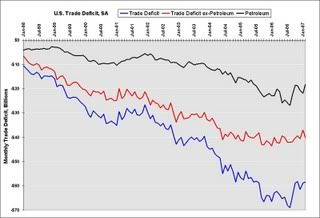
1.) While the trade deficit appears to be moderating, it is still at high levels. Here is a chart from the Blog Calculated Risk. The lowest line is the overall trade deficit. The middle line represents oil imports and the top line represents oil imports only. Currency traders are selling the dollar partly because the US consumes more than it makes (which the trade deficit represents).

Photo Sharing and Video Hosting at Photobucket

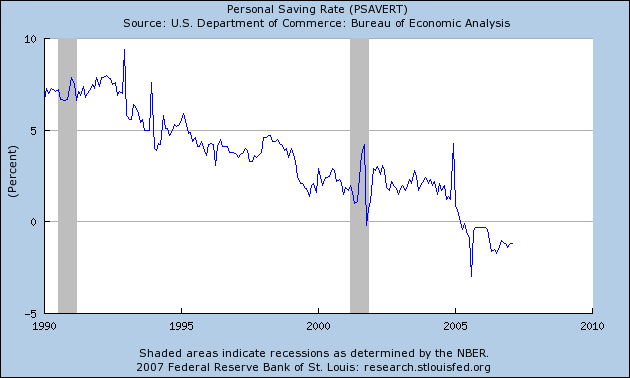
2.) The US savings rate is still negative, indicating the trade deficit must be financed from abroad. So long as the US economy has to have international financing to pay its bills, traders will lose confidence in the dollar.

Photo Sharing and Video Hosting at Photobucket

To finance the trade deficit, the US and its trading partners are engaged in an "economic merry-go-round:"

But another baby step of a 27-basis-point rate increase will do little to cool the steamy Chinese economy or markets. To prevent a faster rise in its currency, the Chinese monetary authorities had to buy a staggering $136 billion in the first quarter alone, bringing China's foreign-exchange reserves to $1.2 trillion.

To buy up greenbacks, the PBOC "prints" yuan, colloquially speaking. The dollars are invested primarily in Treasuries and U.S. agency securities, with the salubrious effect of financing the U.S. budget and current-account deficits, in turn bolstering the dollar and holding down U.S. interest rates.

That this dollar merry-go-round cannot go on forever is at the core of the dollar bears' argument. The massive U.S. current-account deficit has to be funded, either through these political contrivances or capital inflows.

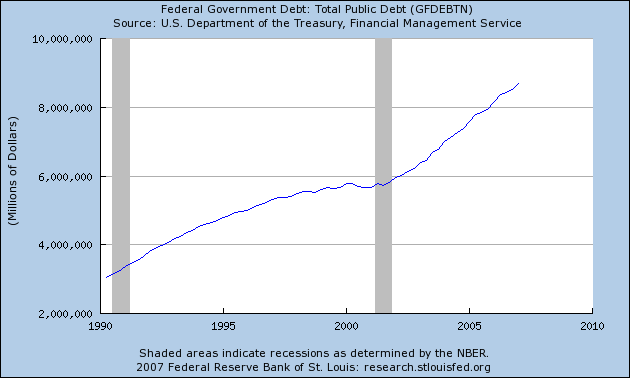
3.) The US Federal Deficit is far from "under control". The figures reported in the press (and by the Bush administration) include the Social Security surplus. Unfortunately, the US government is spending this money now instead of actually saving it (even US politicians have no idea how to save). This means the US will eventually have to pay all this debt back, which means we will have fiscal problems going forward.

Photo Sharing and Video Hosting at Photobucket

4.) Other countries rate of growth is increasing. According to the International Monetary Funds World Economic Outlook, the rest of the world's growth is doing pretty well. That means other currencies are more attractive.

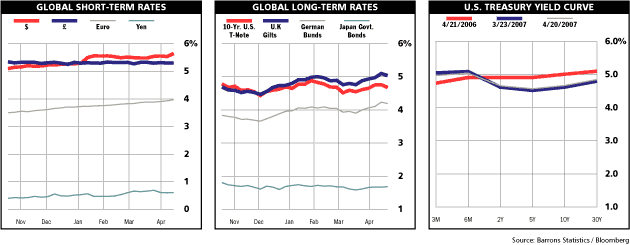
5.) While US interest rates are still some of the best around, other countries/regions are starting to raise their rates for various reasons. As the IBD article noted:

The European Central Bank and policymakers in China and Japan also are leaning toward rate hikes amid relatively robust growth and expectations of higher inflation.

Meanwhile, the Federal Reserve is likely to stay on hold for the foreseeable future. Policymakers are betting that subpar growth will cool inflation, which is still above the Fed's 1%-2% comfort zone.

The EU has raised rates over the last year or so, and Japan actually has interest rates above 0% (they stand at .5% now). While Japan still has a long way to go before they reach parity with the US, their announcement a few months ago to raise interest rates sent a shock through the financial markets as it signaled the carry-trade (borrowing in Japan and lending anywhere else) was no longer a given (the chart is from Barron's).

Photo Sharing and Video Hosting at Photobucket

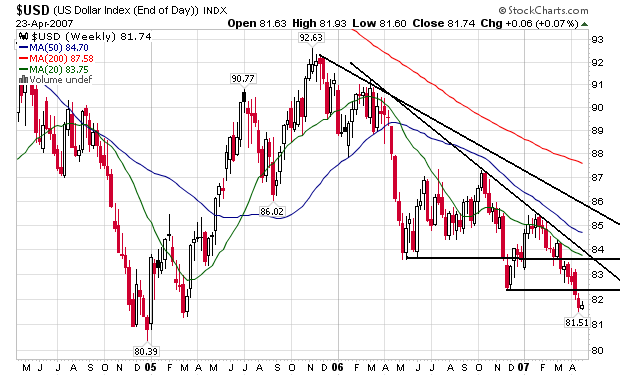
6.) The actual chart of the dollar has nothing but bearish implications. Note the following:

-- The overall trend is clearly down

-- The 20, 50 and 200 day simple moving averages are all heading lower

-- The overall index is trading below the moving averages, meaning price action will continue to pull the moving averages lower.

Photo Sharing and Video Hosting at Photobucket

The conclusion from all this? There is no news that is dollar bullish and plenty of news that is dollar bearish.

For economic commentary and analysis, go to the Bonddad blog

Friday, April 13, 2007

World Economic Outlook report suggests US should worry

A Power Outage At the White House

By David Ignatius

Friday, April 13, 2007; Page A17

Excerpt

What else is there to worry about? "A key question in assessing the risks to the outlook is whether the global economy would be able to 'decouple' from the United States were the latter to slow down more sharply than projected." This is from the latest World Economic Outlook report, prepared by the International Monetary Fund before this weekend's gathering of global bankers and finance ministers.

Rather than deferring to U.S. economic leadership, in other words, the global financiers are worrying about how to get out of the way if our pyramid of debt-financed consumer spending should topple. The IMF projects U.S. economic growth this year to be just 2.2 percent, below the average for advanced economies and less than half the projected growth for the world as a whole.

A telling sign of America's inability to solve chronic problems is the IMF's discussion of our addiction to oil -- something President Bush talks plenty about but lacks the political will or congressional support to change. The IMF has gathered some shocking statistics: U.S. gasoline consumption as a share of gross domestic product is nearly five times that in the other major industrialized countries; gasoline accounts for 43 percent of U.S. oil consumption vs. 15 percent in other countries; fuel efficiency in America is 25 percent lower than in the European Union and 50 percent lower than in Japan. No wonder the world doubts our seriousness on energy issues.

With the White House in decline, interest groups are gaining more clout to influence policy. Treasury Secretary Henry Paulson is working mightily to keep the U.S.-China relationship on track. But the administration recognized political reality this week in filing complaints with the World Trade Organization about Chinese piracy of intellectual property, drawing an expression of "deep regret and strong dissatisfaction" from Beijing. The New York Times, citing a China expert, reported that "Chinese officials appeared to be worried that President Bush was losing his ability to block protectionist moves in Congress."

War on Terror looks like a fraud

April 13, 2007

It's becoming pretty clear that Iraq has been "pacified" solely for the purpose of economic aggression

By JOHN GLEESON

Contrary to the "patriots" who try to use the deaths of our soldiers in Afghanistan to stifle debate on Canada's involvement in the War on Terror, I would say that as new evidence presents itself, we would indeed be cowards to ignore it simply because we've lost troops in the field and are therefore blindly committed to the mission.

And new evidence is piling up around us, arguably strong enough to declare the whole War on Terror an undeniable fraud.

Virtually ignored by mainstream media, the Americans showed their hand this year with the new Iraqi oil law, now making its way through Iraq's parliament.

The law -- which tens of thousands of Iraqis marched peacefully against on Monday when they called for the immediate expulsion of U.S. forces -- would transfer control of one of the largest oil reserves on the planet from Baghdad to Big Oil, delivering "the prize" at last that Vice-President Dick Cheney famously talked about in 1999 when he was CEO of Halliburton.

"The key point of the law," wrote Mother Jones' Washington correspondent James Ridgeway on March 1, "is that Iraq's immense oil wealth (115 billion barrels of proven reserves, third in the world after Saudi Arabia and Iran) will be under the iron rule of a fuzzy 'Federal Oil and Gas Council' boasting 'a panel of oil experts from inside and outside Iraq.' That is, nothing less than predominantly U.S. Big Oil executives.

'Savage privatization'

"The law represents no less than institutionalized raping and pillaging of Iraq's oil wealth. It represents the death knell of nationalized Iraqi resources, now replaced by production sharing agreements, which translate into savage privatization and monster profit rates of up to 75% for (basically U.S.) Big Oil. Sixty-five of Iraq's roughly 80 oilfields already known will be offered for Big Oil to exploit."

While the U.S. argues that the oil deal will give Iraqis their shot at "freedom and stability," the International Committee of the Red Cross reported this week that millions of Iraqis are in a "disastrous" situation that continues to deteriorate, with "mothers appealing for someone to pick up the bodies littering the street so their children will be spared the horror of looking at them on their way to school."

Four years after the invasion, it's becoming pretty clear that Iraq has been "pacified" solely for the purpose of economic aggression. Humanitarian considerations are moot. The awful plight of Iraq's one million Christians, who have no place in the new Iraq, underscores this ugly truth.

Afghanistan, meanwhile, has given the U.S. a strategic military beachhead in Central Asia (which "American primacy" advocates called for in the '90s) and it was quietly reported in November that plans are being accelerated for a $3.3-billion natural gas pipeline "to help Afghanistan become an energy bridge in the region."

With many Americans (including academics and former top U.S. government officials) now questioning even the physical facts of 9/11 and seriously disputing the "militant Islam" spin, with the media more brain-dead than it's been in our lifetimes, now is not the time for jingoism and blind faith in the likes of Cheney, George W. Bush and Robert Gates.

Our young men are worth more than that -- aren't they, Mr. Harper?

Euro hits new two-year high against dollar

Related
Wholesale prices up 1 percent in March


2 hours, 54 minutes ago

The euro surged on Friday to 1.3534 dollars, the highest level since January 3, 2005, on expectations of rising eurozone interest rates.

They added that the foreign exchange market was jittery ahead of a meeting of the Group of Seven (G7) financial chiefs in Washington on Friday, when the health of the global economy and the weakness of the yen are expected to be in focus.

The single currency later stood at 1.3521 dollars, compared with 1.3480 dollars in New York late on Thursday. The euro dipped to 160.06 yen after striking an overnight record of 160.87 against the Japanese unit.

The dollar meanwhile fell to 118.38 yen compared with 119.14 late on Thursday.

"The dollar has been depressed against the euro by the comments of (ECB) President (Jean-Claude) Trichet yesterday (Thursday) following the monetary policy meeting of the European Central Bank," said Paul Chertkow, head of global currency research at The Bank of Tokyo-Mitsubishi in London.

The euro had breached 1.35 dollars on Thursday after the ECB signalled that it was ready to raise eurozone borrowing costs again in June.

Trichet sent a clear signal that the bank was set to raise its key interest rates -- already at a five-and-a-half-year high -- still further in June, after holding rates at 3.75 percent on Thursday.

"Characterising monetary policy as still accommodative, he (Trichet) underpinned the expectation of another 0.25 point increase in the refinancing rate in the eurozone before mid-year," Chertkow added.

The euro has been buoyed in recent weeks by favourable interest rate differentials, analysts said.

In contrast with the ECB, the US Federal Reserve appeared to open the door to a cut in American borrowing costs last month as it kept rates unchanged at 5.25 percent.

Market players were cautious on Friday ahead of the G7 meeting amid speculation that the yen could become a topic of discussion, if only behind closed doors.

The weakening Japanese yen is causing consternation in European capitals, where finance chiefs are worried that the yen-euro exchange rate is penalising eurozone exporters.

"But the chances of strong remarks on a weak yen are very slim this time," said Tokyo-based Commerzbank analyst Ryohei Muramatsu.

"And since foreign exchange rates are stable in an orderly manner right now, there is no need for the G7 to say anything that may possibly disturb the market," he said.

Ahead of the G7 talks, the dollar could face further selling pressure from new data in the United States, with the latest US trade balance data and producer price inflation numbers due later Friday.

The euro was changing hands at 1.3521 dollars, against 1.3480 dollars late on Thursday, 160.06 yen (160.62), 0.6811 pounds (0.6812) and 1.6364 Swiss francs (1.6396).

The dollar stood at 118.38 yen (119.14) and 1.2101 Swiss francs (1.2167).

The pound was being traded at 1.9860 dollars (1.9785).

On the London Bullion Market, the price of gold pulled back to 677.25 dollars per ounce, from 678.50 dollars late on Thursday.