Showing posts with label mortgages. Show all posts

Wednesday, April 11, 2007

The Mortgage Mess

MSN Tracking Image
MSNBC.com

Special Report

Fraud, abusive lending crushes dreams for millions of home owners

By John W. Schoen

Senior Producer
MSNBC
Updated: 8:31 a.m. MT April 10, 2007

Mark and Kerrie Russo, a Jackson, N.J., couple raising two young daughters, are struggling to hang on. Less than a year after buying a home in 2005, which they financed with a 30-year fixed rate loan based on a solid credit history, a local mortgage broker began sending letters offering to refinance their loan. A new product, the sales pitch said, allowed home owners flexibility to choose from a menu of different payments from one month to the next.

What the broker didn’t explain, Kerrie Russo says, is that this was a “negative amortization” loan — an expanding debt that buried the couple deeper in hock even as they thought they were paying down their mortgage balance.

Like many borrowers who were sold mortgages they couldn’t afford, Russo says that when she called the broker to complain, she was told that because she failed to read the fine print, the responsibility for getting in too deep was hers.

After coming up with about $14,000 to get out of the downward spiral into yet another loan, Russo says she’s learned an important lesson.

“I have learned a new term called 'predatory lending,'” she said. “And that is what I am a victim of.”

As hundreds of billions of dollars worth of these loans “reset” to higher monthly payments, many so-called “subprime” borrowers — historically those with shaky credit histories — are sitting on financial time bombs. They’re finding out the hard way that the paperwork they signed may have buried them under a crushing debt load they can’t sustain.

Swindlers and predators
For some, the lesson learned is: “buyer beware.” But a series of interviews with subprime borrowers, mortgage lenders, appraisers, current and former regulators, and the inspector general of the Department of Housing and Urban Development paints a different picture — of a widespread pattern of questionable lending practices and outright fraud that has already sparked a wave of criminal and civil actions against various players in the $10 trillion market for residential mortgages.

Questionable mortgage practices can take on many forms, but the fall into two broad categories:

  • Predatory lending. In this case, complex mortgage terms and interest rate risks were not fully explained as required by federal law. The borrower is usually the victim.
  • Mortgage fraud. In these cases, often carried out by sophisticated swindlers, the lender is typically the victim.

    As the housing market boomed in the early part of this decade, lenders proliferated with deals that often seemed too good to be true. To be sure, some borrowers - eager to "cash out" their rising home equity generated by the housing boom - were too quick to refinance at below-market interest rates and artificially low monthly payments.

    Many of those now facing default and foreclosure failed to do enough homework, relied too heavily on verbal assurances and didn't read the documents they signed closely enough. And not everyone took the bait.

    Ron Melancon of Richmond, Va., was among those who stopped short of the brink. When Melancon and his wife went shopping for a bigger house for their growing family a few years ago, he figured he’d have a hard time getting a mortgage. After a rough patch that left him in over his head with credit card debt, he still had a bankruptcy filing on his credit record.

    But when he stopped in at a model home in a new subdivision, he was surprised to learn that not only was the builder willing to give him a mortgage, but he was told he could qualify for a loan big enough to buy a $400,000 model, which was bigger and better-appointed than the $320,000 house he and his wife felt their budget would handle. Melancon decided to keep shopping for a less expensive house.

    “I just knew from being freshly out of bankruptcy and the experience of going to court and getting your whole life twisted upside down — I just didn’t want to go through it again,” he said. “But it was so hard to back away.”

    When he took a closer look at the terms of the adjustable mortgage he’d been offered, he knew he’d made the right decision.

    “They never told you the whole truth,” he said. “They said the rate could not adjust more than two points in any one year. But they never told you that the first year out of lock it can go as high as 9.99 percent — it was buried in the paperwork.”

    The majority of mortgage professionals that American homebuyers deal with are honest, decent people. But a relatively small group of bad actors has unleashed a wave of fraud and predatory lending over the past several years that threatens to ripple through the wider mortgage market, deepen the ongoing housing slump and crush the finances of countless borrowers who were victims of schemes and abusive practices that have cost them their homes — and their shot at the American dream.

    The federal Truth In Lending Act, passed by Congress in 1968 to protect consumers, requires clear disclosure of all terms and costs in lending transactions. That means it’s against the law for a mortgage broker to misrepresent or fail to fully explain all the risks of a new loan — even the risk that interest rates may go up, according to David Berg, a Texas trial lawyer.

    “Any promises made, fraudulently, knowing they’re not true, that cause the buyer, the mortgagee, to rely on to their financial detriment is a fraud,” he said. “It can be prosecuted on the state or federal level. But it is a fraud.”

    Berg, who says he is getting calls from subprime borrowers who say they were duped, is gearing up to commit “a great deal of our resources” for what he believes “is going to occupy a large portion of our practice.”

    “The reliance on false statements is there,” he said. “I think these are good lawsuits and good criminal cases.”

    As prosecutors, regulators and Congress begin to unravel the problem, it’s not clear just how widely such lending abuses spread during the height of the housing boom. Because mortgage brokers are regulated state by state, there are no federal statistics on fraud and abusive practice in the mortgage industry. But the number of so-called suspicious activity reports related to mortgage fraud, filed by banks and other lending institutions, more than doubled between 2004 and 2006, according to the FBI, which investigates a variety of financial crimes.

    The closest thing to a “mortgage police” is the Inspector General’s Office at the U.S. Department of Housing and Urban Development, where some 650 investigators and auditors are chasing down mortgage fraud and predatory lending cases. In the past three years, they‘ve conducted 190 audits of lenders and brokers, brought 1,350 indictments and won $1.3 billion in court-ordered restitution orders. But it’s not yet clear whether they’ve gotten to the bottom of the problem, according to Kenneth Donohue, who heads the office.

    “You almost have to have a crystal ball,” he told MSNBC.com. “Are we looking at the tip of the iceberg or the iceberg itself? It’s too soon to say.”

    Rising foreclosures
    For many subprime borrowers, the nightmare is only beginning.

    In February alone, some 131,000 foreclosure filings were recorded by RealtyTrac, a Web site that compiles default notices, auction sales and bank repossessions. For all of 2006, the site logged more than 1.2 million foreclosure filings nationwide — or one in every 92 U.S. households, up 42 percent from 2005.

    “Based on our numbers for the first two months of 2007, foreclosure activity is running at a rate that would project to a 33 percent increase over 2006,” RealtyTrac’s CEO James J. Saccacio, said in a news release last month. "It appears that as subprime and FHA loans default at higher-than-anticipated rates, and lenders tighten their underwriting standards, we’re going to continue to see a spike in the number of homeowners facing foreclosure.”

    These statistics represent the end of a process that is costing many borrowers their homes. A rise in delinquency rates — the number of borrowers who are falling behind in their payments — is a harbinger of more foreclosures to come. From a low in 2005, the mortgage delinquency rate has been climbing steadily and is expected to continue to rise through 2007, according to CreditForecast.com, a joint venture of moodys.com and credit agency Equifax.


    And another wave of delinquencies looms, thanks to a newer family of adjustable-rate mortgage products that include “reset” clauses that can raise payments every month, depending on current market rates, and quickly bust a family’s budget. Between the beginning of this year and the summer of 2008, some $650 billion worth of U.S. mortgages — or about 8 percent of the total outstanding — face their first payment reset, according to moody’s.com.

    Not all so-called “subprime” borrowers now facing financial problems have bad credit — or at least they didn’t when they originally applied for a loan. In fact, “there is a surprisingly large share of subprime borrowers with FICO scores above 720 (a level consistent with a good credit,)” Fannie Mae chief economist David Berson wrote in a recent commentary.

    “What I’m looking at very closely at my firm is the idea of misdirecting a trusting individual toward loans that they don’t need,” said Berg, the Texas lawyer. “I worry about young people who’ve gotten themselves into these adjustable-rate mortgages that are going to be reloaded now at a price they can’t afford. A difference of two points can kill a family’s economics.”

    Legitimate real estate and mortgage industry professionals say they are angry and disgusted by the damage done to their businesses by a handful of dishonest players.

    “We will tell a customer truthfully if a loan is not good for a customer: ‘We’re not going to do the loan. You will have to go somewhere else,’” said Morris Capouano, owner of Equisouth Mortgage Inc., a lender with 17 employees in eight states based in Montgomery, Ala. “The sad thing is somebody else is going to do that loan. That’s the broker who is concerned about lining their pockets.”

    Some real estate appraisers say they've been pressured by mortgage brokers to improperly doctor their reports and inflate the value of a home to increase the chances that a mortgage application will be approved.

    “A lot of the smaller guys — the smaller fee shops — they’re very beholden to their clients,” said Diana Yovino-Young, a Berkeley, Calif., real estate appraiser with a family-run business. “So to have even one deal like this go bad — and to basically state the truth — they could lose that client, and that could be 90 percent of their income if they’re a one-person shop.”

    One popular tactic among mortgage brokers looking to inflate a home’s reported value is to pitch the job to multiple appraisers at the same time, said Yovino-Young.

    “They’ll send out a fax and give you the address of the property and they’ll say, ‘Can you come in at $750,000, say,’” she said. “And the first one who calls back and says, ‘Yeah, that’s doable,’ will get the job. Of course, all of this is completely illegal.”

    In some parts of the country, appraisers say, the practice has become so widespread that those who wouldn’t go along saw their business dry up.

    "Every day in my office I received threats, attempts at bribes and was told, 'You make this value,' 'We need it pushed,' 'I’ll give you all my business for the rest of the year,'" said Richard Hagar, a Seattle-area real estate appraiser. "(Mortgage brokers) do not want ‘no’ from the appraiser. They start yelling and screaming."

    Hagar says the pressure ultimately forced him to find other work in addition to appraising. He now teaches state-approved courses on detecting and preventing real estate and mortgage fraud in Washington, Oregon, and Arizona.

    “The fraud problem, it crushed my firm," he said. "I went from 10 appraisers to two. It happened so much, I lost 80 percent of my business.”

    Doctoring the documents
    In addition to predatory lending, which takes advantage of unwitting borrowers, in some cases lenders were defrauded when entire mortgage applications were faked to trick them into approving loans, said many of those interviewed.

    “We have problems with blatant forgery,” said Ed Coleman, compliance coordinator for the South Carolina Real Estate Appraisers Board. “Appraisals are e-mailed to mortgage companies. A mortgage company, if they’ve got the right programs, they can pull a PDF (file). I don’t care if it's protected — they can change it, and they put the signature back on. I’m not computer literate, and I can do it.”

    Lenders say these schemes are sometimes difficult to spot: A bogus tax return prepared with a popular tax software package may look just like a real one. On the other hand, some bogus applications are relatively easy to pick out, according to Capouano, the Alabama-based lender.

    “It’s hard to prove who did it,” he said. “But if the customer provides W-2s to us and the broker provides W-2s and they're altogether entirely different, then we know there’s a problem here. And we’ve seen that happen.”

    Phantom properties
    In one recent case in South Carolina, a home seller was accused of doctoring legitimate appraisals of vacant lots by digitally cutting and pasting pictures of completed houses onto loan documents and submitting them to a California lender, which approved the loans, according to Coleman. No one picked up on the problem until an underwriter from the company happened to be vacationing in Myrtle Beach, Coleman said.

    “He knew they’d had some payment problems with a few people in (the area),” he said. “So he rented a car and drove over to look at these properties — and they weren’t there.”

    In some parts of the country, organized groups prey on first-time homebuyers and other unsophisticated borrowers, the HUD inspector general’s office has found. Illegal aliens, who are enticed into applying for loans with bogus or stolen Social Security numbers, fake tax returns and manufactured employment histories, have become a popular target, according to Donohue.

    “They might be approached by a person who asks: ‘Are you renting a place?’” Donohue explained. “They might speak the same language, and the person would share how much they’re paying. And they’d be told, “Well listen, I can put you in a house for half that.”

    No money down
    Homebuilders who offered easy credit are also playing a role in the unwinding of the subprime market, according to interviews. These builders offer to cover closing costs as a "gift" for buyers with no money to put down.

    “So now you’ve got somebody in a house who put no money down and that additional cost that covers that gift rolls into the mortgage,” said Donohue. “But what you’ve done is you’ve artificially inflated the value of those spec houses. And then you give them a very attractive ARM mortgage that’s going to, as we see, accelerate in the next two or three years.”

    Industry insiders say that borrowers often were encouraged to take out low “teaser-rate” adjustable mortgages with assurances that after a few years of building a solid payment history, they could refinance at the lower, fixed rate available to those with better credit.

    Now, with defaults rising and subprime lenders swamped by bad loans, borrowers who are in over their heads and looking to refinance are seeing interest rates on new loans jumping out of reach.

    “But I believe to this moment there are brokers out there who are doing these loans knowing that the rates have changed and they’re not passing it on to the customer until they sign the document,” said Capouano. “You should never have to go to a closing and be surprised, and that’s obviously happening far too much.”

    According to mortgage brokers, appraisers and regulators, the roots of the problem date to the mid-1990s, when the market for subprime lending began to take off.

    Traditionally, regulated lenders like banks used to make loans directly to borrowers. And those bankers — whose employer’s money was at risk — took the time to understand a borrower's income, job status and the value of the home being purchased.

    But much bigger share of mortgage origination has shifted to unregulated, non-bank lenders who quickly resell these loans to investors, where they may ultimately end up in pools of loans that are bundled by Wall Street investment banks, chopped up into securities and, for a fee, sold off to insurance companies, pension funds, hedge funds and other institutional investors.

    Unlike banks, many of which are supervised by federal regulators, mortgage brokers are regulated state by state. And state rules and licensing procedures vary widely. In about half the states, a single mortgage broker with a license can open an office staffed by an unlicensed sales staff, according Hagar.

    Worse, bad mortgage brokers who are banned in one state can move to another relatively easily — without being detected by regulators in their new home state. Though many lenders maintain their own private databases of bad actors, what’s needed is a national database to track the worst offenders, according to Capouano.

    “There should be a national regulation on how to get licensed: You must adhere to certain guidelines and take tests and continuing education and be always knowledgeable,” he said. “That will push these SOB brokers out of the market. “

    Reviewing the files
    Federal regulations do apply to so-called “conforming” loans sold to quasi-government agencies like Freddie Mac and Ginnie Mae. Loans insured by the Federal Housing Administration, the Depression-era agency set up to manage the world's largest mortgage fund, also carry strict guidelines.

    But oversight of those loans has been getting looser, according to HUD Inspector General Donohue. Beginning about a year ago, FHA began allowing approved lenders to keep their mortgage application files on site instead of forwarding them to the FHA, which now spot checks about 6 percent of those applications, he said.

    “We live by the review,” said Donohue. “It’s at that point — often we get tips and we have a hotline — but it’s at that point that the referrals are made to us. So if you find a red flag in that loan file, it might take you back to a bad lender. You track it backwards.

    “Do I think that a 6 percent review of the total universe is acceptable? You can only imagine how much you might be missing in the process,” he said.

    FHA officials declined an interview request from MSNBC.com for this story.

    Another S&L debacle?
    Some have compared the current wave of mortgage fraud to the savings and loan debacle of the late 1980s and early 1990s, when deregulation of the thrift industry opened the door to widespread abusive lending practices among commercial developers and lenders. After years of trying to roll over bad loans — only to see losses continue to mount – the government finally stepped in with the creation the Resolution Trust Corp. to buy up bad loans. The bill to taxpayers eventually came to $124 billion, according to a 2000 review by the Federal Deposit Insurance Corp.

    So far, no one is suggesting that the total dollar amount of bad loans in the current wave of mortgage fraud will approach that figure. In the savings and loan collapse, commercial mortgages each worth tens of millions of dollars — or more — went up in smoke. Mortgages to subprime borrowers, at the bottom of the real estate ladder, amount to just a few hundred thousand dollars for each borrower.

    But the losers in the savings and crisis were largely professional investors, builders and lenders, many of whom escaped with their personal finances intact. Though taxpayers took a big hit, the impact on individuals was relatively small.

    This time around, the failures of the residential mortgage market are hitting individuals the hardest. Many are on the very bottom end of the economic ladder, duped by brokers and lenders who preyed on their aspirations to home ownership.

    “Because of these few bad apples it is going to affect us, and it’s going to effect the good honest people who really did need this (subprime) program that was available at a reasonable interest rate," said Capouano. “It’s going to push them out of the housing market. It is going to hurt them. And that’s what so sad about all this and so frustrating about all this.

    “The (mortgage) industry was trying to create additional home ownership,” said Donohue. “And that’s very nice, and I think that’s a great thing to allow people home ownership. But at what cost? And to what end does that happen? I think what happened is that people — unscrupulous people — took advantage of that and what they did was go out and solicit prospective buyers.”

  • Home Foreclosures Increasing Above 2001 Recession Levels

    April 11, 2007

    By Bonddad
    bonddad@prodigey.net

    And here's more:

    The percentage of mortgages in default rose to 2.87%, surpassing the worst levels following the 2001 recession.

    "The news is unremittingly bad," CNBC's Steve Liesman said Tuesday. "Delinquency rates were up in 44 of the 50 states."

    The only states where delinquencies didn’t increase were Kansas, Kentucky, Montana, North Dakota, South Carolina and Utah.

    The states with the highest delinquency rates are:

    Mississippi, 4.85%
    Texas, 4.09%
    Michigan, 4.06%
    Georgia, 3.89%
    West Virginia, 3.83%

    Let's put that picture in perspective.

    In 2001 we were in a recession. According to the National Bureau of Economic Research the US economy was in a recession from March to November 2001. Rising foreclosures are a natural consequence of a recession. However, now we are in an expansion, albeit it a slower one. To hit record foreclosures in an expansion indicates there is a big problem somewhere.

    Also consider these jumps in large cities foreclosure rates:

    During the first quarter, foreclosures have jumped sharply across the nation’s top urban markets, according to a PropertyShark.com report released to CNBC.

    In Miami, foreclosures are up nearly 31%, in Los Angeles 24%, and in New York City, up 56%, the website said. Properties in the borough of Queens accounted for the bulk of the New York foreclosures, jumping 91% alone.

    Miami experienced the highest quarterly foreclosure rate per household. In Miami-Dade County, there were 987 residential auctions in the first quarter, which translates into 127 foreclosures per 1,000 households. Miami typically has foreclosure rates higher than the national average because it attracts investors that buy into properties before they’re developed with hopes of flipping them later at a profit.

    Let's add some more statistics that indicate these problems are occurring an an economically significant time.

    According to the BLS unemployment is at 4.4%. That should mean people have plenty of money. And in fact according to the BEA national disposable income actually rose last year, indicating people do have a bit more money.

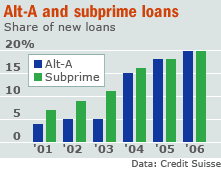
    So what's the problem? Here it is in a nutshell:

    Photo Sharing and Video Hosting at Photobucket

    Over the last 5 years, the percentage of higher risk loans underwriting on a yearly basis has been increasing. Simply put, it looks as though some of those loans were poorly underwritten -- at best.

    There is no way to simply erase all of these loans. We have to let the market run it's course. That means this problem is going to be with us for some time.

    For economic commentary and analysis, go to the Bonddad Blog

    Thursday, March 29, 2007

    US central bank sounds inflation warning

    The World Today - Thursday, 29 March , 2007 12:34:00
    Reporter: Peter Ryan

    ELEANOR HALL: The world's most powerful central banker has sounded a new warning about inflation in the United States and sparked concerns about interest rates.

    The chairman of the US Federal Reserve, Ben Bernanke, said that while he's worried about the high-risk end of the US mortgage sector and that it could contribute to an economic slowdown, he regarded inflation as the greater threat to the global economy.

    Economists say Mr Bernanke's comments on inflation suggest a cut in interest rates is now off the agenda.

    And that has sent some investors on Wall Street running for the door.

    More from our Business Editor Peter Ryan.

    PETER RYAN: For Ben Bernanke, today's world is hardly one of economic stability, with rising oil prices, growing tensions with Iran, and almost daily volatile data usually sets hearts racing on Wall Street.

    It's not much comfort, but there is one constant for central bankers - the ever-present "i" word or inflation.

    BEN BERNANKE: Although core inflation seems likely to moderate gradually over time, the risks to this forecast are to the upside.

    In particular, upward pressure on inflation could materialise if final demand were to exceed the underlying productive capacity of the economy for sustained period.

    PETER RYAN: Ben Bernanke was addressing a joint economic committee on Capitol Hill.

    And he used the opportunity to reign in expectations stemming from last week's decision on interest rates that a rates cut was back on the agenda because of the softer language he was using on inflation.

    But Mr Bernanke reinforced today's message on inflation with tougher words such as "risk" and "uncertainty".

    And he added another touch of reality, confirming that the US economy, while not heading towards recession, is continuing to lose steam.

    BEN BERNANKE: Economic growth in the United States has slowed in recent quarters, reflecting in part, the economy's transition from rapid rate of expansion experienced over the proceeding years to a more sustainable pace of growth.

    PETER RYAN: Another factor, according to Ben Bernanke, is the continuing downturn in the US housing market, which has sent shockwaves through the overall economy, from building companies to the makers of building materials.

    But at the moment, he says it's steady as she goes for the traditional mortgage market.

    BEN BERNANKE: Mortgages to prime borrowers and fixed rate mortgages to all classes of borrowers continues to perform well with low rates of delinquency.

    PETER RYAN: But it's the crisis in the sub prime mortgage sector - risky loans to borrowers with little or no credit history - that appears to be keeping Ben Bernanke awake at night.

    BEN BERNANKE: To the downside, the correction in the housing market could turn out to be more severe than we currently expect.

    Perhaps exacerbated by problems in the sub prime sector. Moreover we could see yet greater spill over from the weakness in housing to employment and consumer spending than has occurred thus far.

    PETER RYAN: The mixed messages of a slowing economy, higher inflation, and little chance of a cut in interest rates despite the housing correction encouraged some investors to take their profits and run.

    Wall Street closed in a gloomy mood, with the Dow Jones Industrial Average and the tech heavy Nasdaq both down 0.8 of 1 per cent.

    And data earlier in the day showing that orders for durable goods rose less than expected last month, only underpinned the pessimism.

    KEN MAYLAND: There really is a slow down going on in the industrial side of the economy and this is probably not the end, we're not at the end of it yet.

    PETER RYAN: Ken Mayland is an economist and president of Clearview Economics in New York. He's also predicting tough times ahead for the US economy.

    KEN MAYLAND: That's a bad signal, that's a sign that more production adjustments are necessary, so I think the next three, four months are going to be pretty tough slugging for the manufacturing side of the economy.

    PETER RYAN: But it's the spiralling price of oil that continues to overshadow the global economic picture.

    It's now up for the seventh day in a row - well above $US 64 a barrel - and the escalating concerns about Iran, particularly from Britain and the United States, could see the oil price remain volatile in the months to come.

    ELEANOR HALL: Business Editor Peter Ryan.

    Tuesday, March 27, 2007

    Housing Bottom? Not After Yesterday's News

    Mar 27, 2007

    By Bonddad
    Bonddad@prodigy.net

    Below is a compilation of posts I made on my blog about yesterday's new home sales numbers.

    There is no way to spin these numbers as anything but terrible. Worst of all, they don't reflect the complete loss of subprime borrowing which will probably send these numbers lower in future months.

    Here's the short version: sales dropped and inventory increased. And it's only going to get worse.

    First -- this report has an incredibly large confidence interval. That simply means the actual number could be plus or minus 17.4.

    The information is from the Census Bureau

    Sales are down 18.3% from February of last year.

    There is now an 8.1 month supply of available inventory. That's a ton of homes.

    The total raw inventory level has increased from 538,000 in February 2006 to 546,000 in February 2007. Remember we saw housing starts increase 9% in February. That means we've got more inventory coming onto the market. My guess is the homebuilders were expecting demand to pick-up a bit this year. These recent starts could mean the market may build an unwanted inventory glut.

    The Northest and Midwest saw big drops -- 27% and 20%, respectively. The weather will be blamed for some of this. The West saw a 24.6% increase. That number doesn't make sense. I am guessing we'll see a revision of that number or the January number sometime soon.

    Also remember that lending standards have tightened over the last few months. That means there will be fewer buyers going forward.

    Also -- the median price increased from 243,200 to 250,000. It doesn't make sense for prices to increase in a decreasing sales market.

    From Bloomberg:

    The supply of unsold homes climbed to the highest in 16 years, the Commerce Department said in Washington today. Purchases dropped 3.9 percent to an annual pace of 848,000 last month. Economists had forecast they would rise to a 985,000 rate, based on the median forecast in a Bloomberg News survey.

    .....

    ``As ugly as these numbers are, they don't reflect the tightening of lending standards, which means sales are going to get worse,'' said Christopher Low, chief economist at FTN Financial in New York. ``The longer it takes for housing to recover, the more the risk it could spill over to other parts of the economy.''

    From CBS:

    Inventories of unsold homes rose 1.5% to 546,000, representing an 8.1-month supply, the largest inventory in relation to sales since January 1991, at the tail end of a recession. The inventory is up 27% in the past 12 months.

    Inventories are probably understated, however, because they don't include homes thrown back on the market due to buyer cancellations

    Record backlogs

    The number of completed but unsold homes rose to a record 179,000 in February from 177,000, up 43% from a year earlier.

    "There is an enormous backlog of unsold new homes that have to be worked off before builders will start building spec homes," wrote Ray Stone, chief economist for Stone & McCarthy Research, in a research note.

    Let's review the points made above.

    1.) Sales are at the lowest level in 7 years

    2.) Inventories are the highest they've been in 16 years -- at the tale end of a recession.

    3.) Inventories are probably higher because of cancellations.

    4.) Tighter lending standards -- which have been recently implemented -- aren't included in these numbers.,

    5.) The number of completed and unsold homes is at a record.

    None of this news points to a bottom in housing. We're not even close.

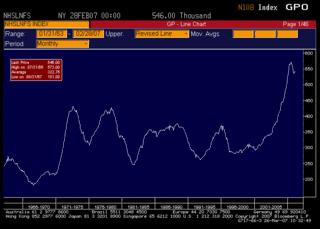
    This graph is from Interest rate roundup a great blog that everybody should read. Not only does it make me miss a Bloomberg terminal, it also shows just how out-of-whack the current inventory level is with historical norms.

    I resized the chart. It goes back to 1963.

    Photo Sharing and Video Hosting at Photobucket

    There's only one way to sell this inventory in a tightening credit market -- lower prices.

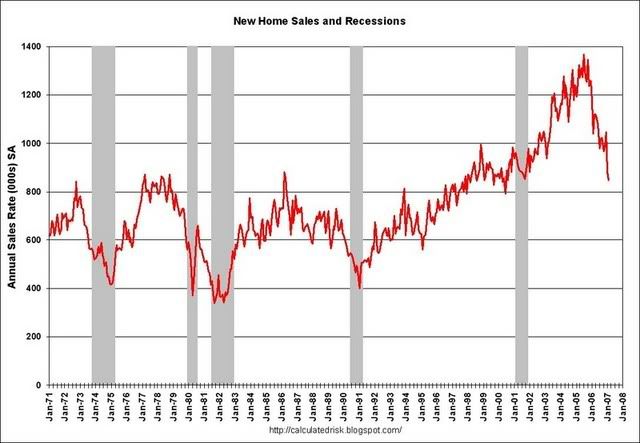
    There's one final chart that is really important. It's from the blog Calculated Risk -- another great blog everyone should read. It shows the relationship between new home sales and recessions. Notice one thing in this chart: The US economy has never had a drop in new home sales of this magnitude without having a recession. That does not mean we will have a recession, just that these two events are pretty strongly correlated.

    Photo Sharing and Video Hosting at Photobucket

    As I mentioned at the beginning, these numbers are uniformly awful. And worst of all, we're seeing housing credit dry up.

    We're nowhere near a bottom yet.

    Friday, March 23, 2007

    Whose Mortgage Crisis?

    Anya Kamenetz

    March 15, 2007

    Anya Kamenetz is a freelance writer, the author of Generation Debt and a journalistic fellow of the Freelancers Union. She can be reached at her website, anyakamenetz.blogspot.com.

    A Mortgage Crisis Begins to Spiral, and the Casualties Mount,” read the headline in The New York Times last week. I clicked on the link expecting to read about the growing numbers of victims of “exploding” subprime mortgages, suddenly stuck with unaffordable payments as interest rates tick up and housing prices fall. Instead, the “casualties” of the headline were the subprime mortgage bankers and brokers, multimillionaires who are losing their red Ferrari convertibles and private jets now that the housing bubble has officially burst.

    Yes, this current stock slump looks to a lot of people like the tech bust 2.0, and it may very well affect the whole economy. The economic big picture is an important angle, also explored by the Times here, here and here.

    But what about the angle involving real people who are actually going to lose their homes? "Subprime" lending is a creature of our recent unprecedented era of unrestricted credit. It is the business of providing mortgages at exceptionally high interest rates to people with poor or spotty credit histories, who in this economy, tend to be lower earners, less educated and disproportionately minority. It also often has an uglier name—predatory lending.

    In the just-passed era of record-low interest rates, the lenders who are now in trouble dangled homeownership before millions of people who never dreamed of such a thing before, enticing people into barely affordable contracts with low introductory rates and zero percent down, helping drive housing prices up and inflating our homeownership rate to the highest in American history. Not to mention minting money for themselves.

    And President Bush bragged about it, because it looked like progress. He repeatedly cut funding for Housing and Urban Development programs, even in the wake of the Katrina diaspora crisis. Yet, because of the proliferation of subprime loans, he was able to tell a black audience in 2005, “Today, nearly half of all African Americans own their own homes. And that's good for our country.” It was the ultimate in privatization.

    Unfortunately, sometimes the risk gets so high that owning is not really owning. The Center for Responsible Lending, a nonprofit that takes on all forms of predatory lending, estimates that predatory mortgage lending costs Americans more than $9.1 billion each year. And African Americans and Latinos are more likely to get subprime mortgages even when they have the same qualifications as whites. "Nontraditional loans in the subprime market are seriously eroding the traditional benefits of homeownership," Michael Calhoun, the Center’s president, has said. "By their very nature, they pose a high risk of losing valuable home equity or foreclosure."

    Now the brokers are going to take some losses and switch to trading something else—fine for them. But what about the millions of marginally middle-class people stuck up to their neck with higher and unaffordable monthly payments? Their futures hold delinquency, defaults, foreclosures and bankruptcy.

    According to Barron's , during the next two years homeowners can expect increased monthly payments on an estimated $600 billion of subprime mortgages. The last quarter of 2006 had a record rate of foreclosures. Senator Christopher Dodd, D-Conn.,, the chairman of the Banking Committee, told reporters that the next 18 months may bring as many as 2 million more.

    America is at another Enron moment. Rather than shedding a tear for the traders who pumped up this market, we are now required as a country to reexamine the responsibility that creditors have to borrowers—to make a sane assessment of the ability to repay, not merely to make as much money as they can out of the risk. It is high time to block predatory lending of all kinds by reinstating usury laws, limiting interest rates, penalties and fees that creditors can charge.

    Will our Democratic lawmakers accept this moral challenge? The jury’s still out. On the one hand, 14 Democratic senators voted for the credit-industry-authored bankruptcy bill in 2005. On the other hand, Senator Carl Levin, D-Mich., recently held some pretty harrowing hearings on predatory credit card industry practices, in which he raked over the CEOs of the top three credit card issuers in the country.

    Several lawmakers, including Ted Kennedy, D-Mass., and Hillary Clinton, D-NY, have introduced reforms of the extremely predatory practices of student lenders. And Senator Chris Dodd and Representative Barney Frank, D-Mass., are each discussing introducing legislation on subprime lending, Dodd to protect the borrowers already trapped and Frank to restrict these risky mortgages going forward.

    I have high hopes that predatory lending could become the moral values issue of 2008. In the meantime, let’s keep in mind who the real casualties are.

    Subprime Meltdown Snares Even Borrowers With Better Credit

    Subprime Meltdown Snares Borrowers With Better Credit (Update3)

    By Jody Shenn

    March 22 (Bloomberg) -- The subprime credit crunch is beginning to ensnare even borrowers with better credit.

    Lenders are increasingly refusing to lend to homebuyers who can't make a down payment of more than 5 percent, especially if they won't document their income. Until recently such borrowers qualified for so-called Alt A mortgages, which rank between prime and subprime in terms of risk. Last year the category accounted for about 20 percent of the $3 trillion of U.S. mortgages, about the same as subprime loans, according to Credit Suisse Group.

    ``It's going to be very difficult, if not impossible, to do a no-money-down loan at any credit score,'' said Alex Gemici, president of Parsippany, New Jersey-based mortgage bank Montgomery Mortgage Capital Corp. Companies that buy the loans ``are all saying if they haven't eliminated them yet, they'll eliminate them shortly.''

    Tighter lending standards may slash subprime mortgage sales in half this year and Alt A mortgages by a quarter, according to Ivy Zelman, a Credit Suisse analyst in New York who covers homebuilders. The new requirements will force some prospective homebuyers to save more money for a down payment or risk being denied credit.

    Pulling Back

    Bear Stearns Cos., General Electric Co.'s WMC Mortgage, Countrywide Financial Corp., IndyMac Bancorp Inc., Goldman Sachs Group Inc., Lehman Brothers Holdings Inc. and Credit Suisse have all said in the last two weeks they're pulling back from buying Alt A mortgages sold with no down payment or in a refinancing of the house's entire value. Such companies facilitate the mortgage market by buying loans and repackaging them for sale as bonds to buyers such as insurers and hedge funds.

    ``We've been warned,'' said Cheryl Hand, manager of Prudential New Jersey Properties' office in Manalapan, New Jersey. She said she's hoping a client of her realty brokerage who's been approved to buy a home with nothing down won't have the loan quashed before the closing.

    Mortgages are categorized as Alt A when they fall just short of the typical standards of Fannie Mae and Freddie Mac, the two largest U.S. mortgage companies. Some mortgage lenders require a credit score of at least 700 for an Alt A mortgage, while others will accept a score as low as 620. The maximum score is 850. The average credit score is in the 600s, according to Bankrate.com.

    Besides some loans requiring no down payment or proof of income, they are often made to buy a second home, a rental unit or to speculate on real estate. Also often falling into the category are loans that are ``option'' adjustable-rate mortgages, whose minimum payments can fail to cover the interest owed.

    Defaults Rising

    Consumers borrowed 100 percent of their home's value on about 18 percent of Alt A loans made last year, according to Bear Stearns, the largest mortgage-bond underwriter. Another 16 percent had loan-to-value ratios above 90 percent as well as limited documentation, they say. The category comprised about 5 percent of new loans in 2002, according to Credit Suisse.

    Late payments of at least 60 days and defaults on Alt A mortgages have risen about as fast as on subprime ones, to about 2.4 percent, according to bond analysts at UBS AG. Loans in the category made to borrowers with low credit scores, equity and documentation are doing about as badly as subprime loans, according to Citigroup Inc. and Bear Stearns analysts.

    Rapid credit tightening that's ``been isolated to the subprime world has really migrated'' in the past two weeks to Alt A offerings that involve borrowing nearly all of a home's worth, said Brian Simon, senior vice president at Mount Laurel, New Jersey-based mortgage bank Freedom Mortgage Corp. ``We're just hopeful it will settle down soon.''

    California Prices

    A borrower would have to come up with $23,750 to make a 5 percent down payment on a typical home in California, based on a $472,000 median price estimated by DataQuick Information Systems in La Jolla, California. She'd have to show enough income to pay $2,730.87 a month with a 30-year fixed-rate mortgage at 6.15 percent.

    ``It doesn't help somebody to get into a home when they can't afford to make the payments and continue living there,'' said Ann McGinley, owner of Action Mortgage, a brokerage in Santa Rosa, California, that's turned away a ``few buyers'' with good credit who may have been able to get loans last year.

    While loans issued only on the basis of the borrower's ``stated'' income can be abused, they're appropriate for a divorcee with alimony who ``doesn't want to show an underwriter her paperwork because it's private'' or a borrower with a reliable roommate, she said. ``I personally have made a couple of real estate agents angry by advising people to not buy.''

    Limits Welcomed

    Some lenders say it's high time that buyers are discouraged from buying real estate with no money down.

    ``Could we have a little skin in the game from the borrower, please,'' said Rick Soukoulis, chief executive officer at LoanCity, a San Jose, California-based lender that stopped making mortgages last week to customers who want to borrow more than 95 percent of the value of their house due to the shrinking secondary market. ``Something to lose if you go into default?''

    LoanCity, which made about $6 billion in mortgages last year, went out of business on March 20.

    The slump in subprime loans has ``drastically eroded'' appetite for bonds backed by Alt A loans, according to a March 9 report by Credit Suisse. The extra yield that investors typically demand on the parts of the securitizations with the lowest investment-grade ratings have risen to 3.50 percentage points over the one-month London interbank offered rate from 2.15 percentage points in September, according to Bear Stearns.

    Resale Woes

    ``If you couldn't sell something, you wouldn't do it either,'' UBS analyst David Liu in New York said. Part of the problem is falling demand for ``piggyback'' home-equity loans used to make down payments, he said.

    New York-based Citigroup will no longer buy home-equity loans made to borrowers who won't prove their incomes and want more than 95 percent of their home's value, according to e-mails from salespeople. Mark Rogers, a spokesman, declined to comment.

    New York-based Bear Stearns, the third-largest Alt A lender according to newsletter National Mortgage News, last week stopped buying such loans without down payments of at least 5 percent. For borrowers not fully documenting incomes or assets, the maximum loan-to-value ratio will be 90 percent.

    Short Notice

    Bear Stearns' EMC Mortgage unit told loan sellers of the changes on March 13, giving them a day's notice. On Feb. 26, EMC said it would start requiring down payments of only 5 percent in the low-documentation category, giving sellers until March 12 to submit loans under the old standards. On March 1, the deadline moved to March 6. EMC didn't change ``full documentation'' programs then.

    People with poor or limited credit records or high debt burdens can take out only subprime mortgages, and typically pay rates at least two or three percentage points above prime loans. Subprime lenders have been increasingly raising their standards since mid-2006, and started cutting out nothing-down lending in late January, Montgomery's Gemici said. People who qualify for prime mortgages don't experience any trouble getting a loan.

    The subprime meltdown might have been prevented if the Federal Reserve had acted faster, a Fed official said today.

    ``Given what we know now, yes, we could have done more sooner,'' Roger Cole, the Fed's director of banking supervision and regulation, told the Senate Banking Committee in Washington.

    Going Forward

    Bear Stearns will finance 25 percent to 30 percent fewer non-prime mortgages this year as it tightens credit, Chief Financial Officer Sam Molinaro said on the company's earnings call last week.

    ``Last year, we did about 50 percent less in subprime than we did the year before,'' Mary Haggerty, co-head of Bear Stearns' mortgage finance department, said in an interview, adding that it has been tightening Alt A standards since December. ``We always try to be ahead of the market.''

    Countrywide Financial, the nation's top home lender, this month stopped making any loans with down payments of less than 5 percent when borrowers are ``stating'' both income and assets.

    Since they have good credit, most borrowers able to take out loans with little down and high monthly payments relative to their pay or potentially rising ones knew the risks, Countrywide Financial CEO Angelo Mozilo said in an interview.

    ``People are adults and made choices in their lives because they wanted to own a home of their own,'' Mozilo said. ``America's great because people can make those decisions for themselves. The complaints about the loans only came when the opportunity for enrichment was gone'' because home prices flattened out.

    To contact the reporter on this story: Jody Shenn in New York at jshenn@bloomberg.net .

    Last Updated: March 22, 2007 15:55 EDT

    America's housing market: Cracks in the façade

    Special Report

    Mar 22nd 2007 | NEW YORK AND WASHINGTON. DC
    From The Economist print edition

    America's riskiest mortgages are crumbling. How far will the damage spread?

    CASEY SERIN knows all about the excesses of America's housing bubble. In 2006 the 24-year old web designer from Sacramento bought seven houses in five months. He lied about his income on “no document” loans and was not asked for anything so old-fashioned as a deposit. Today Mr Serin has debts of $2.2m. Three of his houses have been repossessed; others could share that fate. His website, Iamfacingforeclosure.com, has become a magnet for those whose mortgages are in trouble.

    Mr Serin and people like him are Wall Street's biggest uncertainty just now. How many Americans are saddled with mortgages they cannot afford on houses that are losing value? The answer matters to anyone who bought high-yielding mortgage-backed securities when a booming property market made mortgages look safe. It also matters to investment banks, which packaged the securities and often own subsidiaries that originate mortgages. It may determine whether America's economy falls into recession. It could even affect the outcome of next year's elections.

    Most of the damage so far is in the “subprime” mortgage market, which lends to people whose income is too low, or whose credit history too patchy, to qualify for an ordinary mortgage. On March 13th the Mortgage Bankers Association reported that 13% of subprime borrowers were behind on their payments. Some 30 of America's subprime lenders have closed their doors in the past three months. The cost of insurance against default for the riskiest tranches of subprime debt has soared. The worst effects may not be felt until the mortgage payments of many borrowers with no equity in their homes rise sharply.

    Is this a mere irritant in America's vast economy, or the start of something much worse? Opinion on Wall Street is divided. Most argue that the mortgage mess, though a blight on anyone caught up in it, will not spread. The number of mortgages at risk is too small for defaults to threaten everyone else. Even if a fifth of the $650 billion of adjustable-rate subprime loans went bad, that would be a blip in the $40 trillion market for debt. If repossessions extended the housing downturn, it would not derail an economy that—housing apart—remains healthy, with unemployment of 4.5% and jobs growing strongly.

    Cellar signal

    Growing numbers of pessimists disagree. They think the subprime squeeze marks the start of a broader credit crunch that could drag the economy into recession. Stephen Roach, the famously gloomy chief economist at Morgan Stanley, recently called subprime mortgages the new dotcoms. Just as the implosion of a few hundred internet ventures in 2000 sparked a much broader stockmarket correction and an eventual recession, so the failure of the riskiest mortgages may distress the rest of a debt-laden economy.

    To try to assess who is right, you need to know the share of mortgages potentially at risk. And you need to understand the channels through which subprime defaults could spread to the wider economy.

    America's residential mortgage market is huge. It consists of some $10 trillion worth of loans, of which around 75% are repackaged into securities, mainly by the government-sponsored mortgage giants, Fannie Mae and Freddie Mac. Most of this market involves little risk. Two-thirds of mortgage borrowers enjoy good credit and a fixed interest rate and can depend on the value of their houses remaining far higher than their borrowings. But a growing minority of loans look very different, with weak borrowers, adjustable rates and little, or no, cushion of home equity.

    For a decade, the fastest growth in America's mortgage markets has been at the bottom. Subprime borrowers—long shut out of home ownership—now account for one in five new mortgages and 10% of all mortgage debt, thanks to the expansion of mortgage-backed securities (and derivatives based on them). Low short-term interest rates earlier this decade led to a bonanza in adjustable-rate mortgages (ARMs). Ever more exotic products were dreamt up, including “teaser” loans with an introductory period of interest rates as low as 1%.

    When the housing market began to slow, lenders pepped up the pace of sales by dramatically loosening credit standards, lending more against each property and cutting the need for documentation. Wall Street cheered them on. Investors were hungry for high-yielding assets and banks and brokers could earn fat fees by pooling and slicing the risks in these loans.

    Standards fell furthest at the bottom of the credit ladder: subprime mortgages and those one rung higher, known as Alt-As. A recent report by analysts at Credit Suisse estimates that 80% of subprime loans made in 2006 included low “teaser” rates; almost eight out of ten Alt-A loans were “liar loans”, based on little or no documentation; loan-to-value ratios were often over 90% with a second piggy-bank loan routinely thrown in. America's weakest borrowers, in short, were often able to buy a house without handing over a penny.

    Lenders got the demand for loans that they wanted—and more fool them. Amid the continuing boom, some 40% of all originations last year were subprime or Alt-A. But as these mortgages were reset to higher rates and borrowers who had lied about their income failed to pay up, the trap was sprung. A new study by Christopher Cagan, an economist at First American CoreLogic, based on his firm's database of most American mortgages, calculates that 60% of all adjustable-rate loans made since 2004 will be reset to payments that will be 25% higher or more. A fifth will see monthly payments soar by 50% or more.

    Few borrowers can cope with such a burden. When house prices were booming no one cared. Borrowers refinanced or sold their homes. But now that prices have flattened and, in many areas, fallen, those paths are blocked.

    The greatest difficulties threaten borrowers whose house is worth less than their mortgage. Just under 7% of all American homeowners had this “negative equity” at the end of December 2006 estimates Mr Cagan, using a sample of 32m houses (see chart 1). Among recent homebuyers, the share is even higher: 18% of all people who took mortgages out in 2006 now have negative equity. A quarter of all mortgages due to reset in 2008 are in the same miserable state (see chart 2).

    Higher payments and negative equity are a toxic combination. Mr Cagan marries the statistics and concludes that—going by today's prices—some 1.1m mortgages (or 13% of all adjustable-rate mortgages originated between 2004 and 2006), worth $326 billion, are heading for repossession in the next few years. The suffering will be concentrated: only 7% of mainstream adjustable mortgages will be affected, whereas one in three of the recent “teaser” loans will end in default. The harshest year will be 2008, when many mortgages will be reset and few borrowers will have much equity.

    Mr Cagan's study considers only the effect of higher payments (ignoring defaults from job loss, divorce, and so on). But it is a guide to how much default rates may worsen even if the economy stays strong and house prices stabilise. According to RealtyTrac, some 1.3m homes were in default on their mortgages in 2006, up 42% from the year before. This study suggests that figure could rise much further. And if house prices fall, the picture darkens. Mr Cagan's work suggests that every percentage point drop in house prices would bring 70,000 extra repossessions.

    The direct damage to Wall Street is likely to be modest. A repossessed property will eventually be sold, albeit at a discount. As a result, Mr Cagan's estimate of $326 billion of repossessed mortgages translates into roughly $112 billion of losses, spread over several years. Even a loss several times larger than that would barely ruffle America's vast financial markets: about $600 billion was wiped out on the stockmarkets as share prices fell on February 27th.

    In theory, the chopping up and selling on of risk should spread the pain. The losses ought to be manageable even for banks such as HSBC and Wells Fargo, the two biggest subprime mortgage lenders, and Bear Stearns, Wall Street's largest underwriter of mortgage-backed securities. Subprime mortgages make up only a small part of their business. Indeed, banks so far smell an opportunity to buy the assets of imploding subprime lenders on the cheap.

    Discredited

    Although subprime is a small direct threat to Wall Street it could still inflict pain on bankers—and the broader economy—in other ways. Investors are shunning subprime and all mortgages that seem risky. Spreads have dramatically widened on the securities backed by riskier mortgages and the pooled and debt-laden collateralised-debt obligations (CDOs) based on them. The issuance of subprime-related CDOs has plunged. That is a worry, because investors' appetite for these securities fuelled the boom in riskier mortgages.

    Lenders' reluctance and tightening loan standards may combine to form a classic credit crunch. Several lenders, including Countrywide, America's largest mortgage lender, have stopped making no-money-down mortgage loans. HSBC has cut back on second-lien loans. Freddie Mac recently announced it would no longer buy some subprime loans. No one is sure how dramatic, or lasting, the pull-back will be, but Credit Suisse thinks the number of originations in subprime markets could fall by some 50% in the next couple of years and Alt-A loans may fall by a quarter. Even if the shift is confined to America's riskiest mortgages (and there is little evidence yet of tighter lending standards spreading), its effects may climb up the housing ladder.

    Just when some would-be buyers find it harder to borrow, rising numbers of repossessions will increase the supply of homes for sale. The backlog of unsold homes is already high, at over 3.5m existing homes, or more than six months' sales. Counting the properties that have already been repossessed—and hence are all but certain to be for sale—that figure rises by about a fifth. Add the likelihood of some 1m more repossessions as adjustable-rate mortgages are reset, and you have the makings of a housing glut.

    Falling demand and soaring supply bodes ill for construction and house prices, the main ways housing affects the broader economy. Builders have already cut back. The pace of housing starts is down 33% from its peak in January 2006. Plunging residential investment is the main reason America's GDP growth has slowed to 2.2%. But, as Nouriel Roubini and Christian Menegatti point out in a recent report, that retrenchment is modest by historical standards. In the seven construction busts since 1960, housing starts fell, on average, by 51% from their peak. The mortgage crunch makes matters worse. To work off inventories, builders will have to cut back more, dragging output growth down for longer. Job losses in construction and related industries, which have so far been mild, are likely to rise sharply.

    A glut of unsold homes will also push down prices, particularly in areas such as California and Florida, which had a disproportionate share of riskier loans. House prices have already been falling in parts of both states, as they have in Midwestern states, such as Michigan, where manufacturing industry has shed jobs in recent years. Will those declines accelerate and spread?

    By many measures, America's house prices are still too high. David Rosenberg of Merrill Lynch points out that the ratio of income to housing costs is still some 10% worse than its historical norm and 20% worse than levels at the end of the last housing downturn in the early 1990s. Take out a chunk of potential borrowers; add in some repossessed homes and house prices could be hit hard. If falling prices raise the rate of default, that could in turn worsen the credit crunch, putting yet more pressure on prices. Wall Street's gloomiest seers think average house prices could fall by 10% this year. If so, the economy could well enter a recession.

    Consumers have shrugged off the housing slowdown thus far: real consumer spending is still growing at annual rate of some 3%, thanks largely to strong job and wage growth. But they are unlikely to shrug off a 10% plunge within one year, particularly since America's homeowners have become used to their housing wealth rising by well over 5% a year. No one is sure just how responsive consumer spending is to changes in house prices. Economists normally reckon that a $100 drop in wealth eventually reduces spending by $3-5 a year. But some recent studies suggest the “wealth effect” from housing may eventually be more than double that. Given that Americans have $20 trillion of housing wealth, a 10% price drop could easily halve the pace of consumer spending growth, sending the economy perilously close to recession.

    Such a dramatic drop in national house prices this year is possible, but not yet probable. Unlike share prices, house prices rarely plunge in nominal terms. Unless repossession forces a sale, homeowners prefer to sit tight when markets are weak. If house prices stagnate, consumption may suffer a little, but not too much, so long as jobs stay plentiful and wages grow. If so, the mortgage crunch will be a grinding drag on America's economy; one that unfolds over several years, hitting some people and some regions hard, but not, in itself, a macro-economic disaster.

    The bursting of the stock-market bubble in 2000 led to a plunge in investment at American firms. To stave off recession, the Federal Reserve loosened monetary policy. Short-term interest rates fell to historic lows, propping up consumer spending, but also fuelling the housing bubble and sowing the seeds of today's upheaval.

    Any such loosening is much less likely today. As the statement at their meeting on March 21st made clear, America's central bankers are still more worried about inflation than about recession. And with reason. Core consumer price inflation, which excludes the volatile categories of food and fuel, has accelerated, to 2.6% at an annual rate in the three months to February. With inflation higher than they would like, the central bankers are in no hurry to slash interest rates. They would lose little sleep if output growth stays sluggish or unemployment rates inch up.

    The Senate and the houses

    In contrast to the dotcom bust, then, the consequences of the housing market's troubles may be felt more sharply on Capitol Hill than at the Fed. Politicians, particularly the Democrats now in charge of Congress, are clamouring for quick action. Hillary Clinton has declared the market “broken”, accused the Bush administration of standing by and demanded something be done. Chris Dodd, chairman of the Senate Banking Committee and another Democratic presidential candidate, is also up in arms.

    George Bush often boasts about rising rates of home-ownership under his watch. Hundreds of thousands of repossessed homes, many of them from borrowers who are black and poor, would be politically incendiary. The Centre for Responsible Lending reports that half of the mortgages taken out by blacks in the past few years were subprime. If a fifth of those default, one in ten recent black homebuyers may end up losing his house. Many of these people have stories to tell of being duped into taking on mortgages that they did not understand and could not afford.

    Pressure is mounting to right the wrongs—real and perceived. Attorneys-general from New York to California have started to investigate fraudulent mortgage lending. Rather as after Enron, the securities regulator in Massachusetts has demanded that UBS and Bear Stearns hand over internal details of their research coverage of subprime lenders. Congress has already held hearings on predatory lending. More are planned.

    Ideas abound on what must be done. Mrs Clinton has called for a “ foreclosure time-out”. Pressure groups want Congress to rewrite the rules of the Federal Housing Administration (FHA), a federal organisation charged with providing affordable mortgages to the poor, so it can refinance subprime mortgage loans in default. Calls for other types of bail-out will rise.

    America's four federal bank regulators are also scrambling to respond. Earlier this month they proposed stricter lending guidelines on adjustable subprime loans. But federal regulators play a limited role in subprime markets. Many of the riskiest mortgages were made by independent, non-bank lenders—such as New Century, Ownit and Fremont. These outfits (which are now collapsing) are overseen by state regulators, not federal ones—and the quality of state oversight varies widely. Only half of states have laws against predatory lending. Many lack rules requiring lenders to perform criminal background checks on brokers, as federal guidelines require.

    Few doubt that the subprime mess was, in part, a regulatory failure. But now the mistakes have been made, the biggest risk is that populist politicians rewrite the rules hamfistedly. Fraudulent activity should be punished. The vulnerable need protection from predatory lenders. But an ill-conceived swathe of new “consumer protection” could easily make matters worse. If restrictive regulation scared investors away from the subprime market for good, that really would hurt the poor.

    URL

    Fed Accused of Encouraging Subprime Loans: 'Perfect Storm’

    Fed accused of subprime ‘perfect storm’

    By Eoin Callan, Edward Luce and Krishna Guha in Washington

    Published: March 22 2007 18:50 | Last updated: March 23 2007 00:33

    The Federal Reserve helped create a “perfect storm” in the US subprime mortgage market that could expose up to 2.2m more Americans to the threat of home foreclosure, Chris Dodd, chairman of the Senate Banking committee, said on Thursday.

    Mr Dodd, who is also a Democratic Party candidate for the 2008 presidential nomination, alleged the Fed had failed in its oversight role when the growth in high-risk “adjustable rate mortgages (ARM)” to risky borrowers was exploding.

    ADVERTISEMENT

    While questioning leading mortgage lenders and federal banking regulators, Mr Dodd also promised legislation to crack down on predatory lending in the US mortgage market, where a rising level of repayment delinquency has caused global market jitters during the past month.

    Mr Dodd said that US regulators had relaxed guidelines on mortgage lending at precisely the point in 2004 and 2005 when the riskiest ARM loans – which impose initially light monthly payments that escalate quickly at a later date – were increasing most rapidly. That also coincided with the start of the Fed’s consecutive 17-stage rise in rates.

    “Despite those warning signals the leadership of the Federal Reserve seemed to encourage the development and use of ARMs that, today, are defaulting and going into foreclosure at record rates,” he said.

    Mr Dodd, who was supported by Richard Shelby, the senior Republican on the committee, also expressed frustration at the fact the Fed had so far failed to issue promised guidance to tighten controls on the $1,200bn subprime mortgage market.

    An estimated 1m subprime borrowers will have their rates adjusted sharply upwards this year and another 800,000 next. Roger Cole, a senior Fed official, said the guidance would come out by May at the earliest. But he conceded that the Fed could have done more.

    Thursday’s hearing could mark the start of a backlash against leading subprime mortgage lenders. Senior executives from four of the leading lenders – HSBC, Countrywide, WMC Mortgage, First Franklin – testified. Of those invited, only New Century, the largest subprime lender, declined to send a witness.

    Mr Dodd said the lenders had engaged in “unconscionable and deceptive” practices. But he also admitted that it would be hard to pass a stricter law.

    The Center for Responsive Politics, a watchdog, said New Century more than doubled its Washington lobbying efforts between 2004 and 2005 and contributed $342,000 in campaign funds to candidates in last year’s mid-term congressional elections.

    Mr Dodd said lenders had engaged in “unconscionable and deceptive” practices.

    The Coming Mortgage Metldown

    Mar 23, 2007

    By Bonddad
    bonddad@prodigy.net

    The housing market led to the massive increase in subprime loans over the last three or so years. Underwriting standards were continually relaxed until only a pulse was required to get a loan. Now the proverbial chickens have come home to roost. 44 lenders have now either closed their doors, declared bankruptcy or sold off their assets. And in all probability it will get much worse.

    The excerpts are from a WSJ (sub. required) editorial titled Mortgage Meltdown.

    The primary argument advanced by housing bulls right now is the damage of subprime mortgages will be contained. However, consider these numbers:

    Far from being limited to the subprime market, the data show these risky loan features have become widespread. According to Credit Suisse, the number of no or low documentation loans -- so-called "liar loans" -- has increased to 49% last year from 18% of purchase loans in 2001, a nearly three-fold increase. The investment bank also found that borrowers put up less than a 5% down payment in 46% of all home purchases last year. Inside Mortgage Finance estimates that nontraditional mortgages -- mostly interest-only and pay-option ARMs that allow the borrower to defer paying back principal or even increase the loan balance each month -- which barely existed five years ago, grew to close to a third of all mortgages last year.

    The Alt-A market, a middle ground between subprime and prime, has increased seven-fold since 2001 and accounted for 20% of home-purchase loans last year. Fully 81% of Alt-A loans last year were no or low documentation loans, according to First American Loan Performance. Why have borrowers employed this kind of risky financing? Because it was the only way many of them could afford a home in some of the hottest housing markets, where prices more than doubled in five years.

    Let's break these numbers down.

    According to Credit Suisse, the number of no or low documentation loans -- so-called "liar loans" -- has increased to 49% last year from 18% of purchase loans in 2001, a nearly three-fold increase

    This is a poorly written sentence. I am assuming he means that nearly half of all subprime loans were "liar loans". This would make sense as credit standards have continually deteriorated over the last few years.

    borrowers put up less than a 5% down payment in 46% of all home purchases last year.

    This has a few very negative implications.

    1.) Americans aren't saving. Period.

    2.) There is little home equity, which would help to cushion the effects of dropping prices. This prevents homeowners from refinancing mortgages.

    3.) Lending standards have really deteriorated.

    Nontraditional mortgages .. increased to a third of all mortgages last year.

    That means there are a ton of highly questionable loans on the market. This is probably one reason why the number of delinquencies has increased so dramatically over the last year.

    The Alt-A market, a middle ground between subprime and prime, has increased seven-fold since 2001 and accounted for 20% of home-purchase loans last year. Fully 81% of Alt-A loans last year were no or low documentation loans,

    An overwhelming majority of the middle tier of mortgage risk has no documentation. That means for practical purposes, these are subprime loans.

    Here's where the real problem is going to come in.

    It's not the size of foreclosure losses as a share of the economy that matters, it is the effect those losses have on the availability of credit. When banks (and investors in mortgage-backed securities) begin suffering losses, they inevitably pull back. This is why so many subprime companies have gone bankrupt virtually overnight; investors balked at buying subprime loans except at a steep discount, which produced immediate losses. In effect, their ability to profitably finance new loans was eliminated.

    What's more, the bank regulators are only now beginning to tighten lending standards and will be under increasing pressure from Congress to do more. After growing by nearly 50% in the first half of 2006, nontraditional loan growth has turned negative since the bank regulators issued new guidelines last September. The CFO of Countrywide recently told an investor conference that 60% of the subprime loans the company is making won't meet proposed federal rules likely to take effect during the summer. The concern that tighter lending standards could reduce access to financing is the reason a widely watched survey of homebuilders conducted by the National Association of Homebuilders dropped earlier this week.

    First, Countrywide is one of the largest mortgage lenders in the country. And over half of the loans they are currently making won't be made when new lending standards take effect. That means there will be a severe credit contraction, which is never a good thing.

    The ride is going to get bumpier.

    For economic analysis and commentary, go to the Bonddad Blog

    US housing, mortgage woes contagion feared

    ANALYSIS

    WASHINGTON --For months as the U.S. housing market unraveled, the Bush administration, the Federal Reserve, and most economists maintained the decline did not risk hitting the economy at large, but economists are growing increasingly concerned the broad economy may take a hit.

    An abrupt exodus of more than two dozen so-called subprime lenders from the market has heightened fears other lenders may soon start choking off credit to businesses and consumers.

    Economists, and the Bush administration, agree falling house prices and rising defaults by borrowers with poor credit in the subprime mortgage market may mean slower U.S. economic growth this year.

    "We know that the housing market will have an impact on GDP over the next six months," Edward Lazear, chairman of the White House Council of Economic Advisers, said this week.

    When asked how subprime mortgage market troubles would weigh on the economy, Lazear said the banking sector was still strong, but delinquencies are high and lenders, even outside of the subprime market, have begun to tighten up credit.

    "It's clearly going to increase the cost of capital and on the margin its going to be less conducive of capital spending," said Richard DeKaser, chief economist at National City Corp. in Cleveland.

    According to the Mortgage Bankers Association's most recent data, the proportion of mortgages in the initial stages of foreclosure during the fourth quarter of last year hit its highest in the 37-year history of the association's survey.

    In addition, commercial banks have tightened their lending standards. According to the Federal Reserve's most recent Senior Loan Officers Survey released last month, which covered lending business at the end of last year, domestic banks reported tightening standards on all residential mortgages, the highest net fraction seen since the early 1990s.

    "The extent of the tightening of credit conditions for borrowers has yet to be fully clarified, and bears continual monitoring," Citigroup economist Steven Wieting wrote in a report this week.

    About 45 percent of bank loan officers in the Fed survey said they expect a deterioration in the quality of the loans they make, ranging from loans for business investment to commercial real estate loans.

    --MORE--

    Suburbs of Cleveland are spending millions to maintain vacant houses as they try to contain real-estate panic

    March 23, 2007

    Foreclosures Force Suburbs to Fight Blight

    SHAKER HEIGHTS, Ohio — In a sign of the spreading economic fallout of mortgage foreclosures, several suburbs of Cleveland, one of the nation’s hardest-hit cities, are spending millions of dollars to maintain vacant houses as they try to contain blight and real-estate panic.

    In suburbs like this one, officials are installing alarms, fixing broken windows and mowing lawns at the vacant houses in hopes of preventing a snowball effect, in which surrounding property values suffer and worried neighbors move away. The officials are also working with financially troubled homeowners to renegotiate debts or, when eviction is unavoidable, to find apartments.

    “It’s a tragedy and it’s just beginning,” Mayor Judith H. Rawson of Shaker Heights, a mostly affluent suburb, said of the evictions and vacancies, a problem fueled by a rapid increase in high-interest, subprime loans.

    “All those shaky loans are out there, and the foreclosures are coming,” Ms. Rawson said. “Managing the damage to our communities will take years.”

    By ERIK ECKHOLM

    --MORE--

    Tuesday, March 20, 2007

    Is the U.S. economy headed for depression? : Schoen, MSNBC

    And why don't we just outlaw all these risky loans?
    COMMENTARY
    By John W. Schoen
    Senior Producer
    MSNBC
    Updated: 1:53 p.m. MT March 18, 2007

    OK, everybody. Let’s take a deep breath.

    This week, like everyone reading the headlines, Answer Desk readers are a tad nervous about this whole housing market, subprime mortgage lending debacle. Yes, it’s complicated. And even economists and other experts can’t agree on just how bad it will get.

    But readers like Michael in Colorado — who see a full-blown depression coming — are getting a little ahead of themselves. And while it may seem like a good idea to just ban all these risky loans — as David in Washington suggests — that may be going a little too far. Meanwhile, subprime borrower Latrice in Detroit is looking for some tips on refinancing her loan.

    At this point in time, there's nothing but a big-fat-gigantic depression coming through the front door — and everyone but the most naive and "true believers" knows it. Its gonna be very, very bad. I think the jig is up. The facade is rotting away — quickly.
    — Michael A., Denver, Colo.

    There are certainly plenty of indications that things may get worse before they get better.

    Economists and officials like Fed Chairman Ben Bernanke and Treasury Secretary Henry Paulson are correct in saying that — at this moment, today — the U.S. economy remains healthy. The question is what happens next, which no one, not even the sagest of economists, can predict. Economies are like mobs: they can get ugly, but you really can’t tell when or if the riot will start or how long it will last.

    But a little perspective is in order. Some of us watching the current mortgage meltdown and stock market gyrations remember the real estate slide and stock market crash of the 1980s. (Others, including some of the younger mortgage brokers who made all these risky loans that are now going up in smoke, apparently weren’t around then.)

    The lending problems in the 1980s — both in the savings and loan mortgage market and the junk bond mania on Wall Street — were much worse that anything we've seen so far today. When it was all over, more than 1,000 thrift institutions, holding $519 billion, had been closed down in the “greatest collapse of U.S. financial institutions since the 1930s,” according to a summary report by the Federal Deposit Insurance Corporation.

    At the worst of the 1980s crunch, we heard respected forecasters talk about 50 percent drops in housing prices and dire predictions of impending economic doom. Bookshelves sprouted titles like “How to Prepare for the Coming Economic Collapse” complete with advice on stocking up on canned goods.

    But when the dust settled, the depression of the 1990s didn’t happen. Yes, we had a fairly nasty recession in 90-91, the housing market unraveled (home prices fell somewhat or were flat for many years in some markets), major commercial developers went bust, Congress had to write a check for over $100 billion to clean up the mess, and some S&L cowboys who wrote junk bonds that weren't worth the paper they were printed on went to jail. Within a few years, the economy was back on its feet again. Within a decade, the Fed chairman was worrying outloud about “irrational exuberance.”

    It’s often said that economic cycles, and the markets that finance them, swing between fear and greed. Today, with the “fear factor” on the ascendancy, it’s useful to consider the scale of economic devastation brought by the Great Depression. Between 1929 and 1933, U.S. Gross Domestic Product fell from $103.6 billion to $56.4 billion — a 46 percent contraction that took 10 years to retrace. By contrast, the 1990-91 recession that followed the late 1980s housing collapse lasted 8 months, and GDP dropped by about 1 percent.

    You can never say never again, but there are a number of reasons to believe that the odds of seeing another contraction on the scale of the Great Depression in your lifetime are pretty remote. The 1930s actually produced two back-to-back contractions; since then, historians have unearthed a number of government and businesses mistakes that actually made things worse and prolonged the agony.

    Those lessons learned may help explain why modern recessions tend to be shorter and shallower than the panics and busts of earlier economic upheavals. From 1854 to 1919, for example, there were 16 downturns lasting an average of 22 months, according to the National Bureau of Economic Research. From 1919-1945, the average downturn lasted 18 months. From 1945-2001, the average recession lasted just 8 months.

    While any recession is painful, recent downturns have been relatively mild by historical standards. One useful measure is the number of people who lose their jobs. In the recession of mid 1970s, the unemployment rate jumped from 4.6 percent to 9 percent. In the 1980-82 slump, the jobless rate shot up from 5.7 to 10.8 percent. In 1990-91 it went from 5.0 percent to 7.8 percent. In 2000, after falling to 3.8 percent, the jobless rate hit 6.3 percent in 2003 before dropping back to 4.5 percent today.

    So before you buy a gun, fill your car with canned goods, and head for the woods – take a deep breath. The economy maybe headed for a rough patch. But it’s done so every ten years or so in our lifetime, worked out the problems that caused it to stumble, got up and dusted itself off, and went on its merry way. Your forecast is as good as mine. But, based on what’s going on today, we’re betting against a catastrophic, Hollywood-movie-style economic collapse.

    Given the current situation with home loan defaults, the collapse of several major lending institutions, and the high possibility of a further decline in home values does it not seem like fair time to make ARM and Zero Interest loans illegal? These loans are not safe to the U.S. economy and allow too much risk into the capital markets. It just seems by requiring banks to charge an even rate over the term of the loan, we can secure our markets protecting both the consumer and the banking industry.
    David S. Maple Valley, Washington

    Now that the damage is done, you’re going to see plenty of regulators come out of the woodwork. If anything, the risk is that they over regulate and create a “credit crunch” for worthy borrowers who aren’t overextended.

    But you can't ban or eliminate risk: it's a part of every economic transaction. The purpose of the capital markets is to let everyone kick the tires of that risk, decide how much extra they're going to charge for it, and mark up the return on their investment to make up for the odds that it might blow up and go to Money Heaven.

    What seems to have happened this time around is that either: 1) mortgage lenders who wrote subprime loans weren't completely forthright about the specific risks when they sold off the loans to Wall Street or 2) there was so much demand for these loans from investors that Wall Street looked the other way. (Or both.)

    There’s nothing wrong with option ARMs and interest-only loans — when the circumstances are appropriate. (If you can get someone to give you a zero interest loan, by the way, you should take it.) Many of the loans now in default weren't bad products: they were just the wrong product for that borrower.

    For example, a builder who plans to sell a house when it’s done can save money with an interest-only construction loan: He knows he's going to get a big check to cover the principal when he sells the house. For the lender, it makes sense because the loan is secured by the land and the house.

    And there's nothing wrong with a lender giving a loan to someone with less-than-stellar credit and charging a higher rate to cover that risk. That's a good thing for people who can afford the loan who might not otherwise qualify. On the other hand, if a home buyer can’t afford a conventional monthly mortgage payment, setting them up with a loan that relies on both their income and home value rising rapidly is a risky thing to do.

    Rather than banning these “exotic” mortgages, you’ll probably see more rules about disclosure. There’s is some indication that some of these loans were not properly explained to the borrowers who took them on. In some cases, this may have constituted fraud, which is a crime.

    Something to think about next time you here that phrase: “Don’t worry, just sign here.”

    We took out what would be considered a subprime loan at a fixed rate of nearly 11 percent. We would like to refinance to obtain a lower interest rate. We plan to remain in our home for at least another 8 to 10 years. Can you give us some helpful tips with regards to financing at a better rate?
    — Latrice Detroit, Mich.

    You really won’t know until you shop around: lenders are not all the same. Some may have a lot of subprime loans out and don’t want to write new ones. But there are plenty of solid lenders out there, and the mortgage market will continue to offer new loans.

    “Subprime” includes a number of different circumstances. If your credit history has been spotty, make sure all your bills are current when you go for the loan. The less non-mortgage debt you’re carrying, the better. If you didn’t make a significant down payment the first time around, you may have to put up more money to refinance. And if you got one of those mortgages that was light on paperwork, be prepared to come up with tax returns, bank statements, and anything else the lender asks for.

    So find a list of mortgage brokers in your area, call them up, find out if you qualify and ask them for the best rate you can get. You may be surprised how differently lenders react to the same application.